
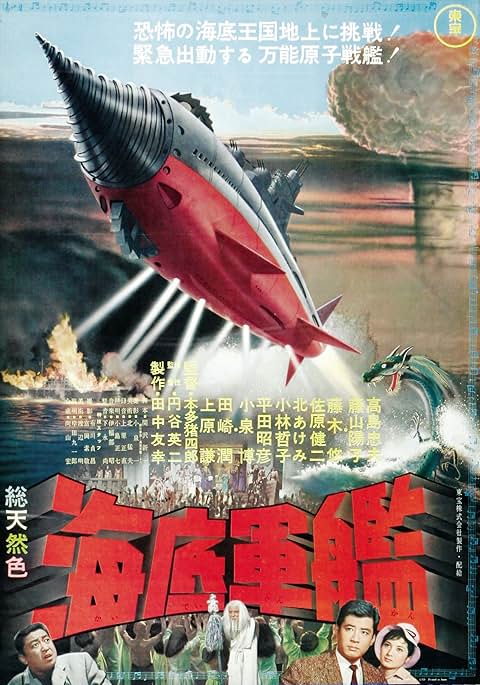
Ishiro Honda rightfully is held aloft as one of Japan’s leading purveyor of sci-fi and adventure primarily because of his most famous creation, the city stomping King Of The Monsters the world recognises as Godzilla. However, if we were to look past the massive form of the huge, irradiated lizard, we would find that Honda actually had quite the sizable catalogue of genre blending movies to his name that seemingly sucked in numerous inspirations at random in order to bring his familiar traits and themes to Japanese cinema screens.
Take Atragon, a movie that even for a 1960s Japanese sci-fi fantasy film, is really fucking weird. You name it, this movie has got it: a lost undersea city waging war on the surface world, giant underwater dragon gods, intrepid photographers, convoluted spy stuff, flying submarines and even a WWII era captain who refuses to believe that Hapan lost the war. But with all this chaotic flotsam and jetson buzzing around, can Atragon hope to gain any form of narrative cohesion? Well, not really, but it’s certainly interesting watching it thrash around.

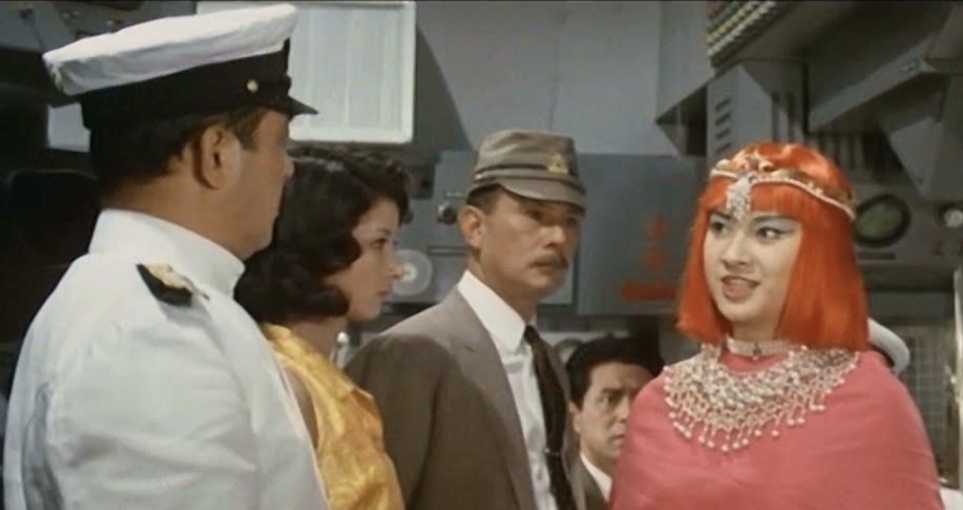
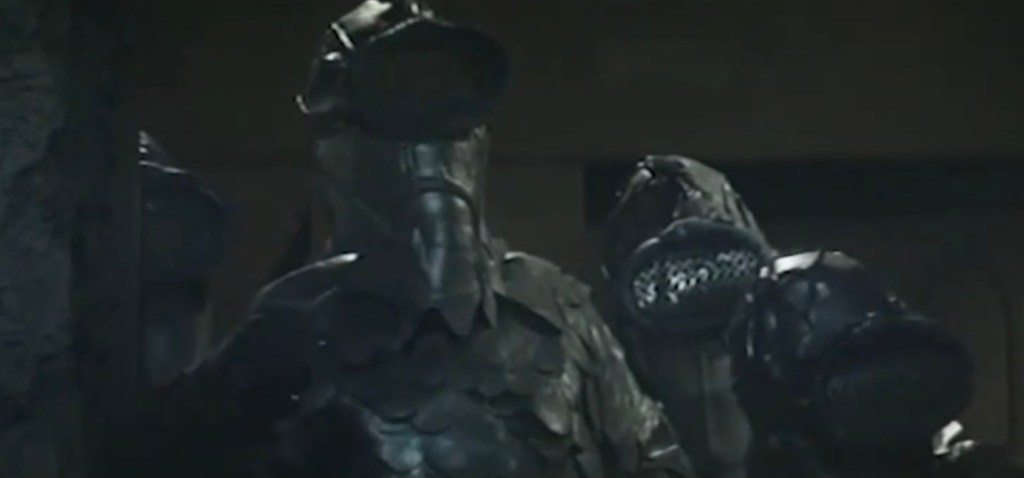
Moderately sleezy photographers Susumu and Yoshiro are on a photo shoot one night when they witness a car suddenly drive into the ocean while strange figures clad in silver are spotted bobbing in the water, but when they tell their strange story to the authorities, they are met with disbelief. However, while there they manage to eye up Makoto Jinguji, the daughter of a deceased submarine captain who is worried that she is constantly being watched by a strange man from the shadows. However, when this random group meet along with retired Rear Admiral Kusumi, things start to eventually make sense when they are almost kidnapped by an enemy agent disguised as a taxi driver. You see, it seems that the Atlantis-like legendary lost continent of Mu has decided to do more than just flourish at the bottom of the sea and has chosen to make a move to dominate the surface world with random kidnaps and terrorist acts. However, while the people of Mu enjoy the element of surprise, weapons that can destroy cities, a giant serpent God named Manda and a super-submarine stolen from the military, there’s one thing that can apparently thwart them – a secret, experimental, Atragon class super submarine named Gotengo that’s been overseen by Imperial Captain Jinguji who doesn’t seem to be anywhere near as dead as reports made out.
With Gotengo seemingly the only real chance mankind has against the genocidal forces of Mu, it seems that all his daughter and Kusumi have to do is simply convince him to take his tricked out war machine and turn it on the world’s enemies – but it turns out that Jinguji doesn’t quite see things the same way. Twenty years after the war has finished, Jinguji is adimant that Gotengo must only be used to restore Japan’s honor and the rest of the world can go take a hike. Can this stubborn relic of wartime Japan be made to realise that we’re all in this together?
If the premise of Atragon sounds like it’s got more moving parts than it can handle, rest assured that it’s just as messy in practice too. Honda literally throws enough stuff at his cramped story to service at least two or three movies as numerous genres such as spy, adventure, sci-fi and fantasy fight tooth and nail to try and give this ambitious but overloaded epic some sense of identity. Maybe if all this insanity had a certain giant, radiation breathing Kaiju standing in the middle of it to give it some focus (it worked for Ghidorah: The Three-Headed Monster) Atragon might have felt more like a single cohesive story than six or seven utterly random ideas bolted together by some nutty inventor.
Still, you can’t accuse Honda from not trying to deliver as much bang for your buck as he possibly can, after all, how many other movies can you name that manages to cram in an invading, undersea empire, a giant snake monster and a flying super submarine that comes complete with a drill bit nose and freeze cannon? But among all these utterly unrelated concepts, the director admirably manages to include many of the continuing themes that also marked many of his more famous entries of the past. There’s a sense of plucky photographers trying to uncover the outlandish truth (even though they start the movie snapping bikini pics), there’s a humanist feeling that the world needs to be pulling together to avoid disaster, a real sense of generational conflict and – of course – there’s that old favorite that has Honda casting a thoughtful eye over post war Japan that crests with Jun Tazaki’s sub Captain who utterly resists the idea of a united planet, even in the face of invading sea men (sorry, not sorry).

Of course, what with this being a product of the 1960s, the result is as camp and cheesy as you’d expect with some adorable model work that includes a genuinely impressive set piece involving an earthquake dropping a city into the earth rubbing shoulders with some rubbery monster work and the evil Mu Queen who dresses like she’s in a Nikki Minaj music video.
However, despite the frenetic, grab-bag nature of the plot, it has to be said that despite including a large stable of reoccurring Honda actors, Atragon suffers by having long periods of inaction as it tries to shuffle its numerous, outlandish ducks in a row. Sure, the last twenty minutes finally delivers a raid on Mu, giant explosions and a (admittedly brief) show down between Gotengo and the snake-like Manda, but it takes quite a while to fully build up to the good stuff.
Still, even though Atragon maybe have been largely forgotten by the world at large, it’s still worth noting that two, rather large aspects of the film went to live on long beyond the events seen here. The first is the snaky form of Manda, a serpent-like kaiju that slithered itself out of Atragon and into the universe of Toho monsters by bagging a supporting role in Honda’s 1968 monster mash, Destroy All Monsters, thud linking himself up as one of Godzilla’s official side-characters. However, even more impressive is that the Gotengo and all of its weird attributes (can it still be considered a submarine if it flies?) got something of a second life thanks to gonzo, Godzilla anniversary movie, Godzilla: Final War as it played a huge role in the excitable extravaganza in sort of a Millennium Falcon role as humans and Kaiju girded their respective loins against an alien invasion.
While Atragon could hardly be described as exactly one of Honda’s best, fans of this era and style of filmmaking will no doubt appreciate all the things the director is trying to say as he attempts to mold a haphazard amount of plot details into something that attempts to makes even a minimal amount of sense. But unfortunately, this stab at frenzied world building and flying submarines only proves to be more like a sub effort…
🌟🌟
 We Have Issues