

For a little while there, I was getting a little worried. When casting an eye over the filmography of Ishirō Honda I was starting to wonder if I was really was a fan of the influential director or I was just enamored of his greatest creation: Godzilla. The reason for my confusion is quite simple; the only real thing separating his Godzilla and his non-Godzilla films is, unsurprisingly, the presence of the Big G himself, but the actual plots all contain the same kind of threads involving mankind dropping their personal shit and uniting to thwart an inhuman foe. However, I find I tend to prefer his Godzilla titles more which leads me to wonder: who exactly am I actually a fan of here?
Well, a definitive answer finally struck me when watching Honda’s conceptually bizarre Kaiju/crime flick Dogora, a movie that divides its time between Lovecraftian tentacle monsters from space and a hard boiled heist flick that sees both parties making mad dashes to snatch up as many diamonds as they can.

The mysterious disappearance of TV satellites in orbit soon gives way to something all the more stranger when there are reports around the globe of vast amounts of diamonds vanishing in weird circumstances. This unsurprisingly raises the alarms of two very different groups; the police, fronted by the diligent Inspector Komai and a gang of diamond thieves who both seem to be incredibly unhappy about this highly expensive turn of events.
Komai enlists the help of crystallographer Dr. Munakata to help him get an angle on the phenomenon, but in turn gets caught up with shifty diamond broker named Mark Jackson, who in turn, is mixed up with that group of gangsters who also are fairly keen to know what the hell is going down.
However, what actually going down is something that’s out of both group’s pay grades as it seems that those missing satellites had collided with with some protoplasmic “space cells” which in turn bathed them in radiation that transformed them into a huge, jellyfish-like creature that’s been sucking up all the diamonds it can find because it needs the carbon to live. Realising that vast space jellyfish aren’t exactly within his circle of experience (where the Hell would you slap the cuffs on for a start?), Inspector Komai leans on Munakata to come up with a solution to a monster – now named Dogora – that comes complete with a trillion dollar appetite.
However, while the world rushes to take advantage of the fact that Dogora’s main weakness is wasp venom (look, just go with it), the gangsters seem unwilling to halt their lawbreaking bullshit in the face of global panic; but after one of their number decides to pull a fast one and the true identity of Jackson is revealed, the two plot threads are due to collide at the worst possible moment.

So, to clear up my little Ishirō Honda conundrum I was rambling about earlier, Dogora finally helped me figured it all out – to lay it our clear, while the distinguished director has always prided himself on trying to do more with his monster movies, even the Godzilla ones, than just have monsters in them doing monstrous things; however, what the problem seems to be is that the majority of more famous Kaiju (Godzilla, Mothra, Rodan) are way more charismatic that the more random ones that pop up in his lesser known titles.
This brings us to Dogora, a sci-fi thriller that, more than anything else, almost seems like Honda was starting to use Kaiju movies to scratch various genre itches he might not have had a chance to do otherwise. Sure, there’s a gargantuan creature from space that has the entire world in the spin and can only be thwarted by random boffins and eccentric means, but the vast majority of of the film is actually a crime film that’s far more concerned with the cops and robbers aspect of the story than it is with the giant, bling sucking tentacle-beast in the sky. Remove the sci-fi and the human stuff would mostly be unaffected as there’s almost a Heat-like tale going on as the cops and the gangsters (made up of the usual faces of Honda’s acting circle) have their own separate things going on. While Yosuke Natsuki’s heroic inspector attempts to figure out what’s behind all these vanishing diamonds, he’s also stuck trying to get the gist of what slippery American, Mark Jackson (possibly the most Caucasian name ever spoken in a Japanese movie) is actually up to. Simultaneously, Jackson is also having dealings with the nefarious jewel thieves who are made up of a group of random criminal personalities such as the grumpy boss, the lanky psycho, the cowardly youth and the turncoat femme fatal who have some internal issues going on themselves. In fact, there are times where you find yourself wishing that there was no monster whatsoever to get in the way of all the cops and robbers stuff as the movie seems perfectly serviceable without it, but it’s still pretty cool that filmmakers were thinking about mashing up such different genres as early as the mid sixties.

Of course, despite the fact that Dogora would probably be better off without Dogora actually being in it, the design of the squiggly bastard is actually a refreshing change from the usual parade of floppy-necked rubber suits that was standard to such films and instead takes the form of an amorphous beast that looks like it would be more at home at the bottom of the Mariana Trench than floating around in the stratosphere jonesing for ice. However, the rather original take is made all the more impressive by eschewing the suit-mation approach and instead gives us a more dynamic creature that undulates like it’s under the ocean and the moment when it extends its tendrils and decimates a bridge is genuinely impressive for a film made in the 60s. With that being said, only a Japanese Kaiju movie made during the Showa era would possibly offer up as wasp attack as a clue to defeating the creature – but I suppose out-there problems require out-there solutions. Simply put, for all his power, Dogora would be powerless protecting a picnic.
However, while Dogora is a diverting Kaiju flick, there’s a very real sense that if it contained a far more famous monster (or weirder yet, no monster at all) it would mist likely result in a far more memorable adventure which pretty much confirms the point I was trying to work out all along.
Yes, Ishirō Honda was a good director who was gifted with a grand imagination and a desire to see the world come together as one, but as fun a director as he was, the presence of Godzilla tended to make his movies much better.
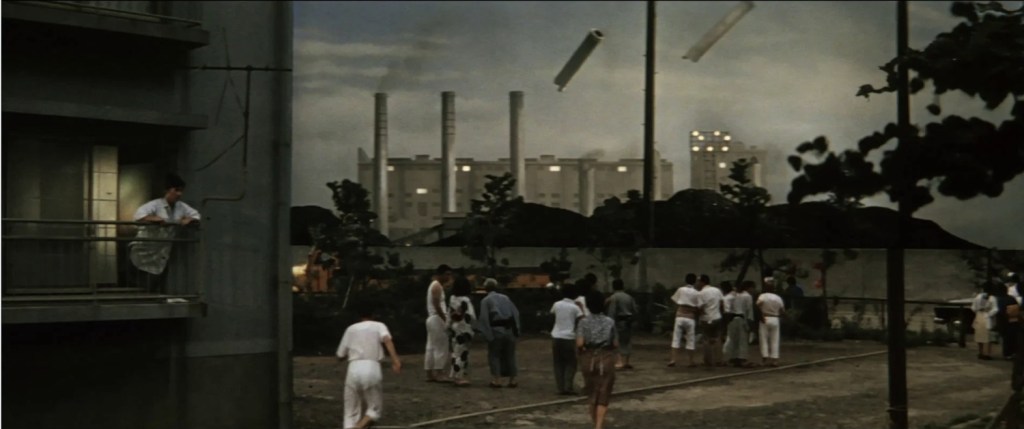
More of a freaky curiosity than a major part of Honda’s legacy, it’s still pretty cool to see how experimental the guy was back in the day when a heist-meets-kaiju flick made today would be highly praised for its originality. However, surely the most impressive aspect of Dogora is that, for once, the human stuff manages to outshine the monster madness like a diamond.
🌟🌟🌟
 We Have Issues
You’re an idiot.
LikeLike