


After taking up the horror baton from the truly seminal, genre defining run of creature features from Universal, Hammer Studios had carte blanche to take now-classic fiends and give them a robust update for the times. Some, like Dracula, Frankenstein and the Mummy got to enjoy a plethora of misadventures, while others, such as the Wolf Man, only got to experience a single reboot courtesy of the English studio and we never even saw an Invisible Man film (pun intended). However, when you consider the calling cards of Hammer to be lush, colour photography, increased sexual content and an excess of high camp, surely the prospect of them tackling Gaston Leroux’s The Phantom Of The Opera would cause even the most driest of mouths to salivate like Dracula in a blood bank.
But sometimes, reality doesn’t quite live up to what you’d hope it would, and despite Hammer drafting in their directorial MVP, Terence Fisher, to oversee matters, we got ourselves an Opera that was a little out of tune.

At the London Opera house, many creative types are busying themselves in trying to bring an ambitious new musical about Joan Of Arc to the stage – however, things are hardly going smoothly. While charismatic producer Harry Hunter does his considerable best to wrangle proceedings into some sort of order, numerous issues keep plaguing the production. For a start, the writer of the opera, the tyrannical Lord Ambrose D’Arcy is a titanic prick who proves to be monstrously disruptive and prone to going off on entitled, egotistical rants; but worse than that, rumours that the opera house is haunted is confirmed when the star hears voices coming from the vents. However, it’s the sudden “suicide” of one the stagehands that finally shuts the production down and with its star refusing to return, the search begins to find a replacement.
Naturally, because he’s a card carrying piece of shit, Lord D’Arcy wants to pull some typical casting couch moves on talented young Christina Charles, but after the continually charming Harry saves her from an ignominious fate, the spiteful composer opts not to hire her despite her blatently having the operatic goods. Someone who also believes that Christina has what it takes is the being known as the Phantom, who not only is actually real, but who has been stalking the entire production from behind a sinister mask. Along with his mute servant, this ravaged individual not only is obsessed with this particular production, but comes to believe that Christina is the only voice who can do it justice – after a little personal training.
But while Christina is kidnapped and brought to the Phantom’s lair under the opera house, Harry goes on a fact finding mission to discover the tragic origins of the Phantom and why he has such a mad-on for Lord D’Arcy.
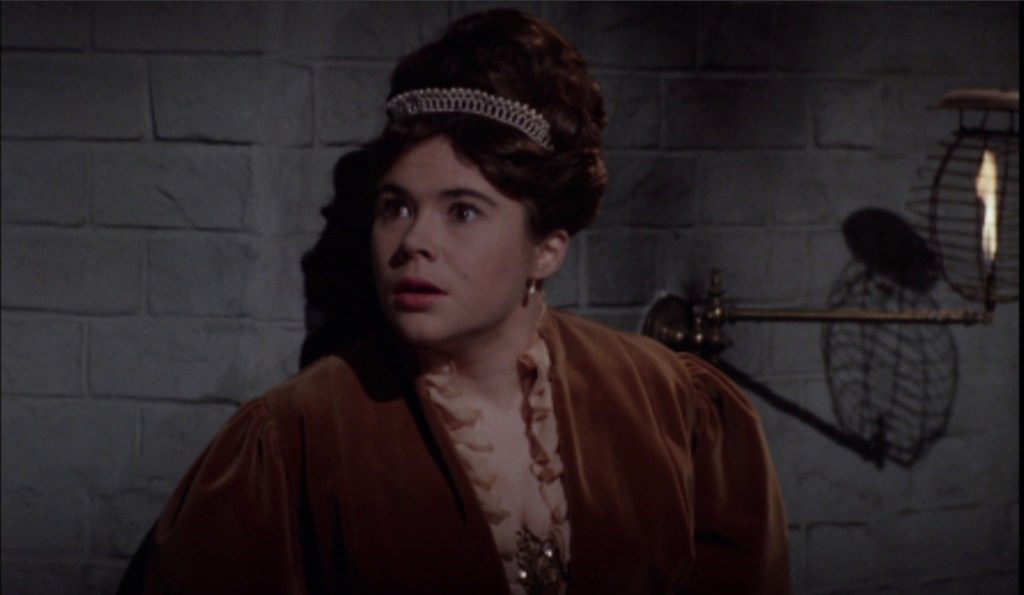
After successfully infusing various horror legends with a new lease on life, you’d expect a Terence Fisher Phantom Of The Opera redux to go harder than a bionic greyhound as lush visuals, panting damsels and iconic reinventions of classic figures of fright were confidently in Hammer’s wheelhouse. However, while there are certainly numerous good points that ensure that the masked musician fits snuggly within that Hammer pantheon, there’s also an array of flat notes that stop it decidedly short of becoming one of its more confident classics. The issue seems to be down to a question of balance and while other versions of the story both past and since have made bold, clear choices, Fisher seems weirdly hesitant to present his Phantom as either a hero or a villain.
The Phantom has been many things over the years – tragic ghoul, sneering slasher, romantic lead, Gerard Butler – but this version curiously makes him neither a lover or a fighter, but instead casts him a doughy, scarred, middle-aged man looking for either payback or just a smidge of recognition. Herbert Lom’s take is far too dusty and unhinged to be dashing, but at the same time he’s not actually much of a threat either, as he leaves all the killing to his diminutive servant who racks up the body count, be it hanging hapless stagehands or stabbing Patrick Troughton’s rat catcher in the face. Also, while Lom’s a great choice to play such a twisted character, the fact that he wears a mask that covers his whole face means that his normally robust performance is subdued by his choice of facial wear. Maybe, he needed a classic villain with more uncontrolled mania to suit his purposes – ironically, his explosive, booming voice would have been more suited to the Invisible Man even if we would have seen even less of his face – but his Phantom is more pathetic than tragic and his lack of killing leave his revenge feeling severely undercooked.
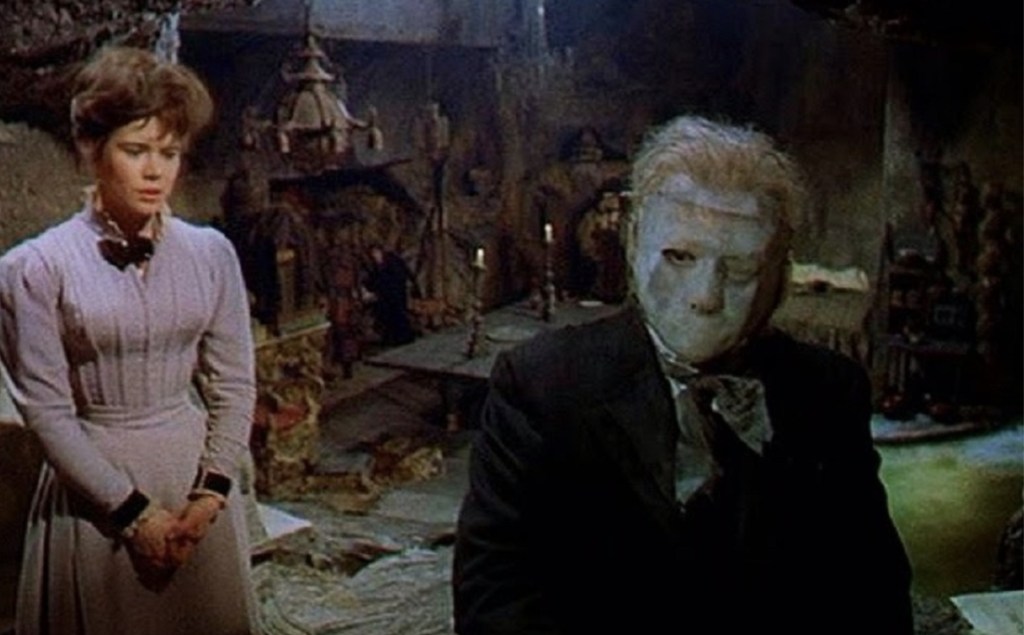
Elsewhere, Fisher also trips up on exactly how much Opera to put into Phantom Of The Opera and the movie is brought somewhat to a crawl whenever the story stops dead in order for the director to mount some musical sequences which seemed placed a odd times throughout the movie. Even the story’s most famous setpiece – the falling chandelier – is muted despite featuring prominently on the one-sheet and switching out the Phantom’s most spiteful attack with something that ultimately gives him redemption is an interesting moves, but it doesn’t quite work.
What does work is the fact that once again, Hammer’s set designers pull out an absolute blinder and give us the goods on an obviously limited budget. The Phantom’s lair is a cross between a dilapidated Batcave and an upmarket flophouse (a four-poster bed, next to an open sewer – how avant-garde!) and the the opera itself may be rather small compared to more grander adaptations, but the level of detail proves to be rather scrumptious. Elsewhere, Lom may be dutifully tragic and Heather Sears and Edward de Souza offer up wide-eyed leads who offer up a diverting sub-plot to discover the Phantom’s origin, but it’s Michael Gough, locked fully into mega-bastard mode, that gives the film that true blast of Hammer camp that the film is desperately missing. Those familiar with his role as Alfred in the Burton Batman movies, the sight of him ranting, gaslighting and letching his way through proceedings proves to be a magnificent experience that you wish had bled into other parts of the film.

While other interpretations of classic fiends manages to give them healthy new leases on life, Hammer’s crack at the Phantom Of The Opera is just too stodgy and decrepit to match up to more iconic versions. While Lon Chaney’s version had a sense of majesty about him, in comparison, Herbert Lom’s take is just too beaten down and busted to evoke anything more than mild pity and he lacks the terrible poetry that burns in his soul that gives his revenge such potency.
While still fun, you can’t help but think that Fisher missed an open goal by not giving the character the iconic pulpy, all-in campness he bestowed on the Phantom’s freaky bedfellows.
🌟🌟🌟
 We Have Issues
Nothing changes, greig again fails to fully appreciate a classic.
LikeLiked by 1 person
Have to say I sadly agree. While good in as far as it goes it does miss something and is a disappointment. Also being only awarded an A certificate when Hammer wanted an X shows they’d messed up.
LikeLike