
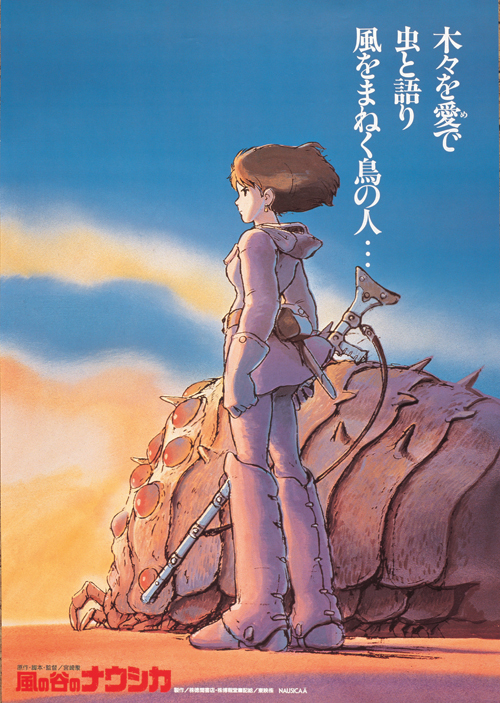

Everything has to start somewhere, and in the case of life-enriching animation house, Studio Ghibli, it began on the winds of a post apocalyptic future. While not technically the first official Studio Ghibli film (the studio was properly founded and delivered it’s first film in 1986 with Castle In The Sky), enough of the key players involved with the animation giant were involved to make Nausicaä Of The Valley Of The Wind something of a remarkable dry run. Directed by Hayao Miyazaki and based on his own Manga, produced by Isao Takagata who went on to direct Grave Of The Fireflies and Pom Poko and scored by Joe Hisaishi, numerous players here went on to become the pillars that created one of the most important animation houses in cinema history.
Whether it can accurately be described as Ghibli’s first movie is a matter for debate, but what isn’t is that it contains all the beauty, imagination and humanity that would go on to mark the studio for decades beyond.
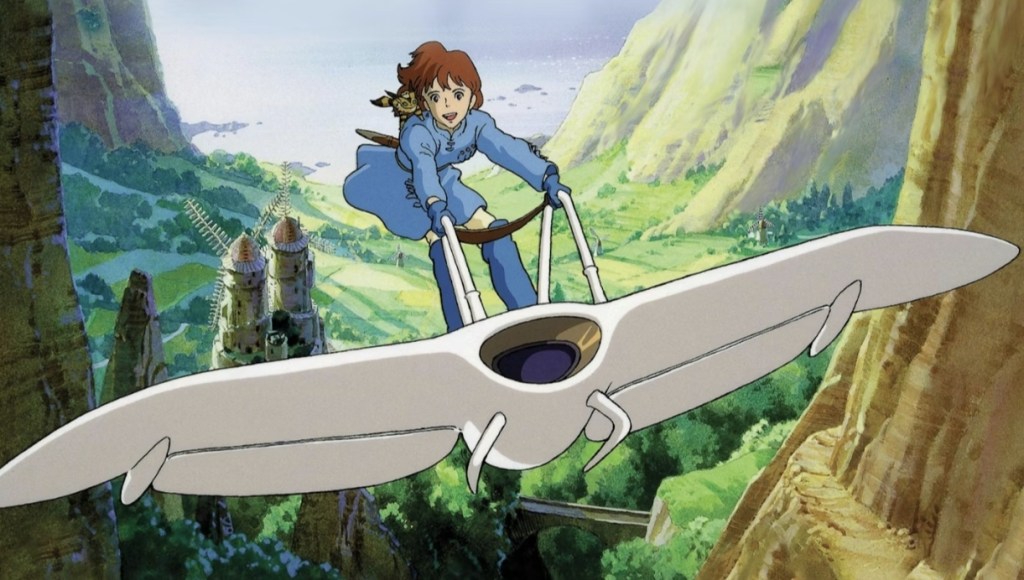
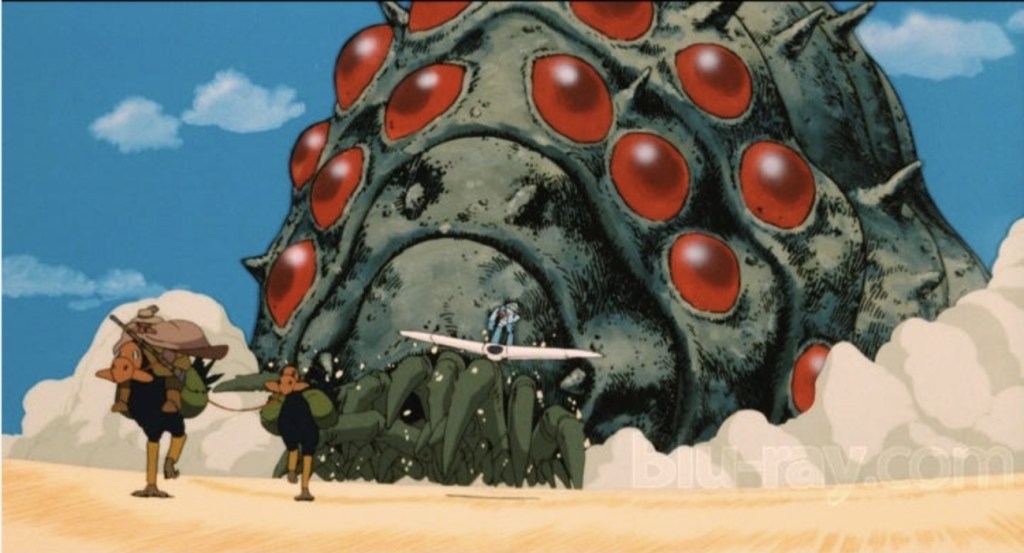
A thousand years have passed since civilisation was destroyed in an apocalyptic conflagration known as the Seven Days Of Fire. Since the ecocide, a huge, poisonous forest has risen known as the Toxic Jungle that not only contains unbreathable spores, but also comes complete with many species of giant, mutant bugs with the most common being the giant, trilobite-like, Ohm. Exploring this deadly environment, we find Nausicaä, the sixteen year-old princess of the kingdom of the Valley Of The Wind, a peaceful society of farmers. Nausicaä is hoping that her explorations will find some way for people and the Toxic Jungle to coexist and we see just how dedicated she is when she manages to save aging swordmaster Lord Yupa from a stampeding Ohm by calming it down using non-violent means.
However, the relative peace experienced by those in the Valley Of The Wind is disturbed when a massive cargo aircraft owned by the militaristic Empire of Tolmekia crashes nearby killing everyone on board, including Princess Lastelle of the kingdom of Pejite, who seemed to be a prisoner. In fact, the only thing that managed to survive intact was the cargo, a huge embryo that had been forcibly taken from the Pejite by the Tolmekia and soon the war-happy nation depends upon the valley led by the embittered Princess Kushana in an attempt to retrieve the embryo and resume their mysterious plans.
It seems that Kuahana has it in mind to use the embryo as a weapon to purge the world of the Toxic Jungle and its poison in order to restore it to what it once was, but to do so will no doubt cause the various species bugs to violently retaliate. Can the level-headed and progressive Nausicaä passively rage against the machine, chill out the bugs and prove to the other kingdoms that the only way to survive is to coexist?
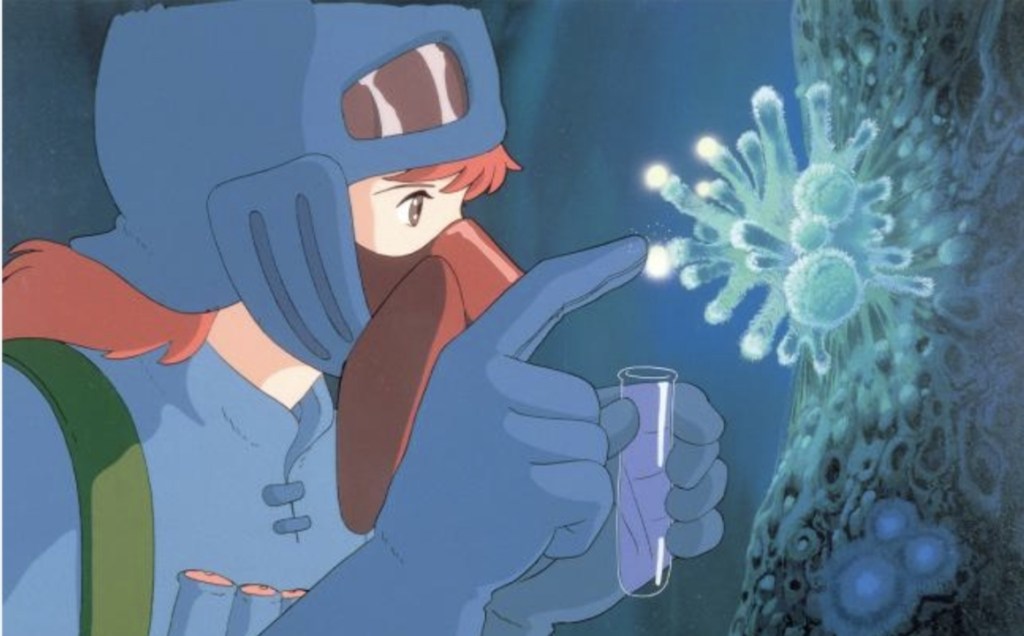
Nausicaä Of The Valley Of The Wind is one of those experiences that somehow both feels deeply indebted to its influences and utterly, utterly unlike anything you’ve ever seen. For example, we’ve certainly seen enough Japanese animated movies that deal with life after a fiery apocalypse – Hell, around 70% of the bastards seemed to operate from that narrative launching point during the 80s and 90s – and what with all the clan of warring kingdoms, savior prophecies and the presence of giant bugs, it’s not long before the spectre of Frank Herbert’s Dune hangs in the air. However, what prevents Nausicaä from being utterly unlike all of its peers (both animated and otherwise) is the peaceful and hopeful outlook it has on life in general. Essentially what Starship Troopers would have been like if Robert A. Heinlein was a pacifist, Miyazaki delivers a spellbinding world that contains so many positive eco-themes and cool retro-futurist tech, it makes James Cameron’s Avatar saga look like it neglects to recycle. We can feel its influences even as far as 2025, because what are the Creepers in Bong Joon Ho’s Mickey 17 if not surrogates for the emotionally complex Ohm, however, while I could take up the entire review suggesting other possible connections to a film the general public may not be fully aware of, I suppose I should get round to turning my attention to the film itself.
Unsurprisingly loaded with plenty of recognizable themes that would go on to make themselves present in the rest of Miyazaki’s work (a strong anti-war sentiment, an affinity for being one with nature, a love of aviation), it’s truly impressive how complete the Ghibli aesthetic was before the studio was even formed. The world building is effortless, casually dealing out new tech, ideals and a shit-ton of exposition in a way that’s organic and impressively easy to digest and as it throws empathetic bugs, warring factions and the usual prophecies in a way that’s both reassuringly familiar and exhilaratingly new.
Maybe I watched too many, violent examples of dystopian Anime back in my formative years, but the main thing that kept me in a state of rapturous attention was that Miyazaki, as early as 1984, was dealing with story that was overwhelmingly positive, while his peers were giving us Mad Max inspired worlds crammed with unimaginable brutality and cruelty. Even more impressive is how the filmmaker handles his themes, coming resolutely from a pacifism standpoint, but never allowing it to mean inaction or abandonment. Nausicaä proves to be something of a sci-fi heroine that deserves way more love than she’s gotten. Yes, she may insist that coexistence and understanding is the way forward rather than kicking ass, but the way she goes about it proves to be just as exciting and thrilling as any standard, exquisitely animated fight scene could be. Whizzing about on her nifty glider like a perky, yet passive Green Goblin, Nausicaä stands by what she believes in to such an extent, she’s constantly getting stuck into potentially fatal scenarios in order to try and talk everyone down and see reason – even giant shelled bugs. It’s just so damned wholesome, but at no point does it veer into preachy and while the animation style may be slightly primitive compared to something as complex as, say, Akira, just because Miyazaki is playing nice, it doesn’t mean he can’t pull out the odd, breathtaking moment involving giant, apocalyptic beings on a rampage, or a huge, bulky cargo plane exploding into a hellish conflagration. Essentially a stunning prologue to an animation house that went on to carry every bit as prestige as Disney or Pixar, Nausicaä Of The Valley Of The Wind proved to be an opening salvo that only got more bewitching as it went on.
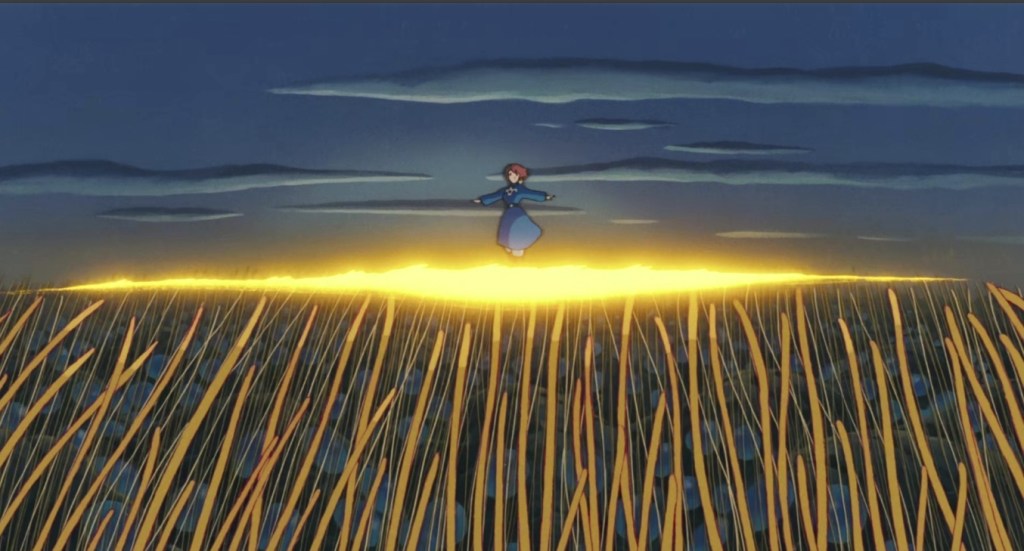
So screw it, if you want to call Nausicaä an official Ghibli, then who am I to argue. After all, not only does it stick to a lot of the ideals that make the animation house so famous, but it technically helped found them. The animation is sublime, the characters beguiling and the quirks wonderful (got to love the wild, fluffy facial hair the Valley people sport), but the most affecting part of this stunning story of bugs and planes is it’s overwhelming humanity. Certainly more of a Ghibli peak, than a valley…
🌟🌟🌟🌟

 We Have Issues
My all time favorite Anime film. Even more so thanks to the refreshed dialogue track that earned the distinguished talents of Patrick Stewart, Edward James Olmos and Uma Thurman. Nausicaa is always one of the most realistic female role models for the sci-fi universe to reflect on, as blessed as the 80s were thanks to female sci-fi heroes like Ellen Ripley and Sarah Connor. It’s appropriate enough that this classic has never been burdened with a sequel or live action remake. Although I can fairly imagine what that could be like as I’m sure others can. Thank you for your review.
LikeLiked by 1 person