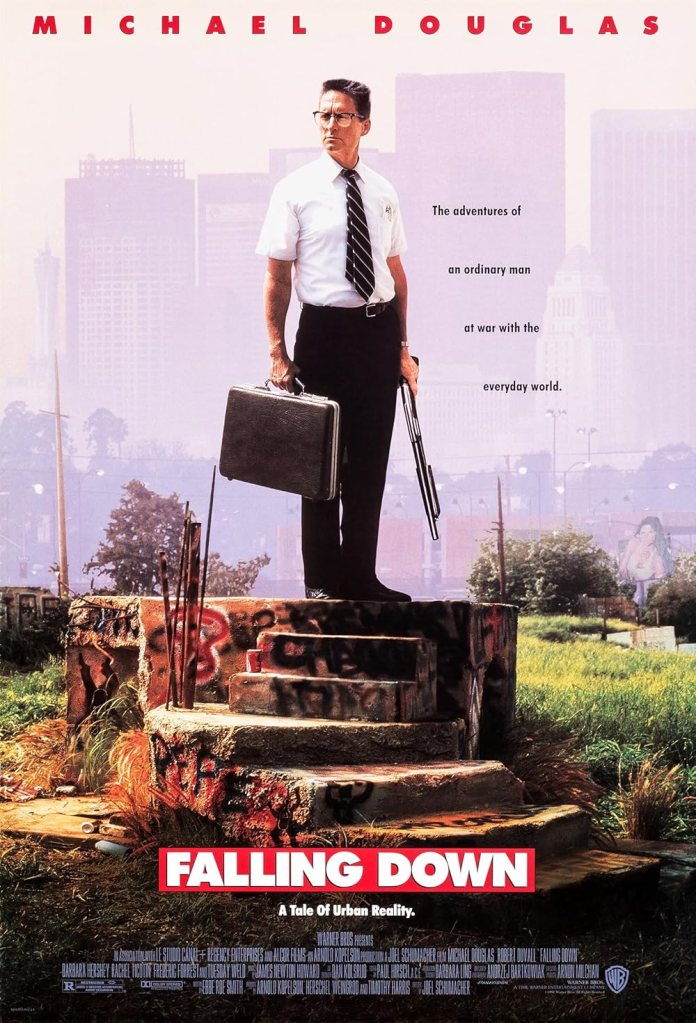

Ah yes, the 90s. A time where you could still have a wide release, blockbuster movie with big stars and an established director that wasn’t afraid to skirt social issues in order to get people talking. It’s getting more and more rare for that to happen these days unless you bury your point under sci-fi/fantasy/horror trappings, but back in 1993, the man who gave us The Lost Boys, and then went on to give us Batman & Robin, delivered exactly such an incendiary blockbuster in the form of Falling Down.
Often referred to as the ultimate angry white man movie, it allowed Michael Douglas to once again court controversy as he goes on an exasperated rampage through a Los Angeles heat wave as he seemingly strikes a blow for common sense. However, while the movie often invites us to see the raging “D-FENS” as some sort of fake it till you make it anti-hero, a timely rewatch reveals Falling Down as a far more complex movie than just violent wish fulfillment for frustrated males.
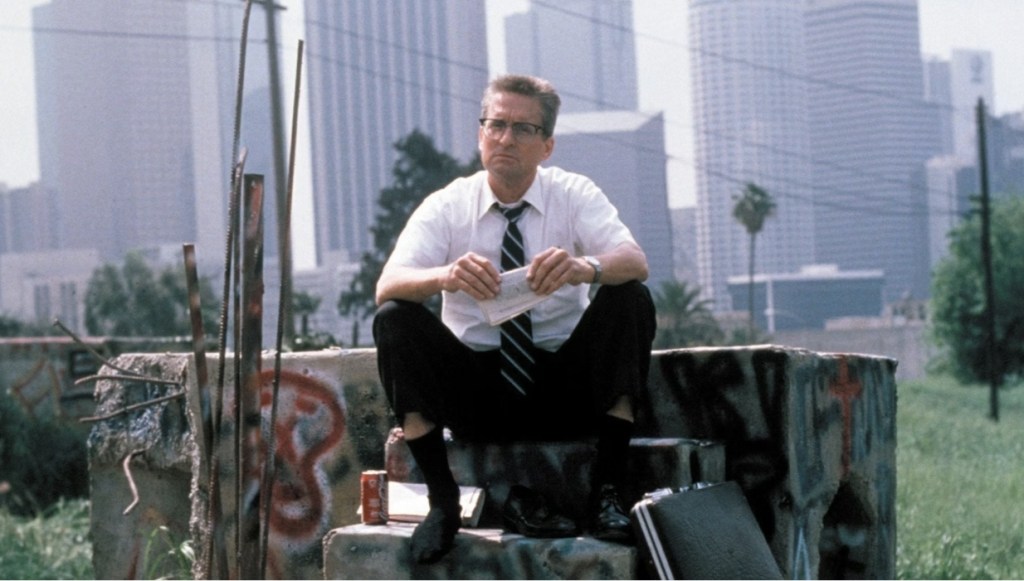
As the sweltering LA heat bathes a loud and belligerent traffic jam in multiple reasons to lose one’s cool, we focus on one man in particular who isn’t taking the noise, stress and temperature very well. The man’s number plate reads D-FENS, and after his air conditioning craps out and a buzzing fly refuses to be swatted, something pings in that overcooked brain of his and he simply gets out of his car and walks away. While D-FENS doesn’t know it yet, he’s about to embark on a peculiar mission that’ll see him single-handedly righting wrongs that have been irking him for a while and he starts by wrecking a Korean owned convenience store when he’s outraged over the price of a can of Coke.
As he moves on from there, he then finds himself in gang territory, but after managing to fend off the two Mexicans, it starts a ball rolling that soon picks up such momentum that D-FENS has no choice but to forge forward with his fucked up quest. Claiming to only want to go home and celebrate his little girl’s birthday, the stakes raise when those pissed gang bangers attempt to get some payback in the form of an ill-conceived drive by and instead end up giving D-FENS access to their gym bag full of guns.
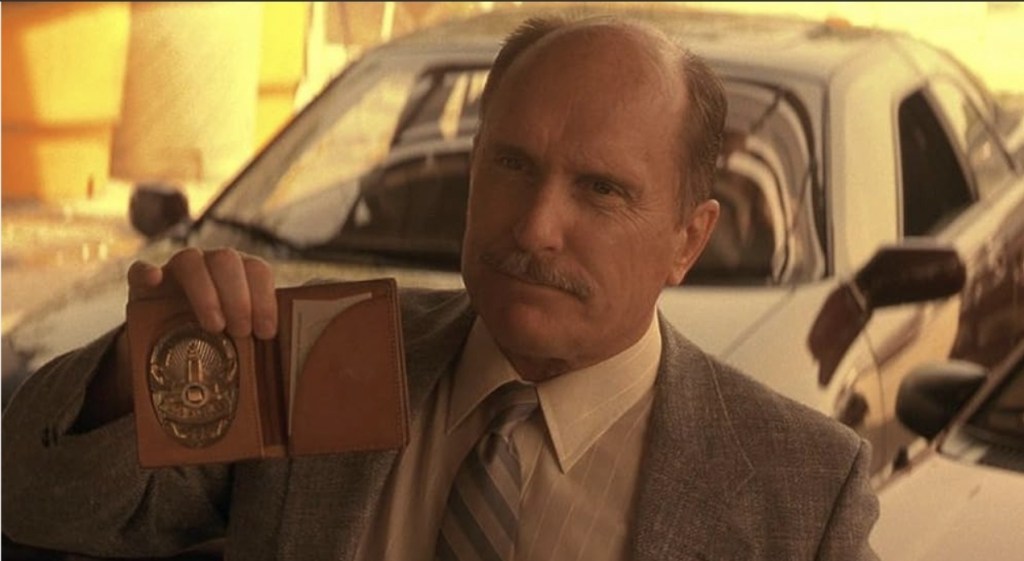
It’s at this point that Sergeant Martin Prendergast starts to see a pattern forming – however, as its his last day before retiring, he’s having a bit of a job getting his colleagues to listen. It also doesn’t help that he’s seen as something of a gentle desk jockey who actively has dodged street work in order to calm his highly strung wife. As D-FENS’ mission to get home picks up pace, Prendergast’s investigation uncovers that this makeshift vigilante may not quite be the innocent victim of circumstance he believes himself to be, especially when we consider how terrified his ex wife seems to be of him. With a final showdown on the cards, is D-FENS merely a misunderstood hero fighting against the injustice of a callous world, or has something terrible been brewing within this man for quite a while…?
There’s something quite refreshing about a movie wearing it’s controversial colours proudly on its sleeve and while maybe Falling Down may not have the grace and eloquence of that other famous meltdown movie, Taxi Driver, it still gleefully forces us to ask some rather uncomfortable questions. On the surface, we were asked to both empathise and demonise Michael Douglas’ D-FENS as a very bad day sends him over the edge and tumbling into the abyss of raging against a society that no longer cares. Sometimes his targets are quite uncomfortable, such as his initial tantrum at an overpriced convenience store as he goes on to berate the Korean owner for having an accent he can’t easily understand. Yes, D-FENS is only looking for a little compassion and understanding, but there’s nothing stopping him from moving on and finding another, possibly cheaper store, but from here his episodic targets range from amusing satire (his machine gun waving rant about breakfast times and meal etiquette at a burger joint; his coronary causing antics at a golf course; his bazooka mishap at some unnecessary road works), to tough-guy posturing (dispatching an entire car-full of Mexican gangbangers purely by accident) and director Joel Schumacher seems to be deliberately switching tactics to keep our opinions as off-balanced as D-FENS’ mental state. Everytime we start siding with our bespectacled anti-hero, the director hits us with some sinister back story that suggests that this rampage has been a long time coming; but before we can see Douglas’s outraged avenger as too much of an unsuspecting villain, the movie will suddenly pit him against a homophonic neo-nazi to thrust him back into more uncertain territory. It may be a dirty trick, but it sure is successful and why pull your punches when your targets are mental health, an uncaring society and those who believe that they’re special enough to take something of a hypocritical stand.
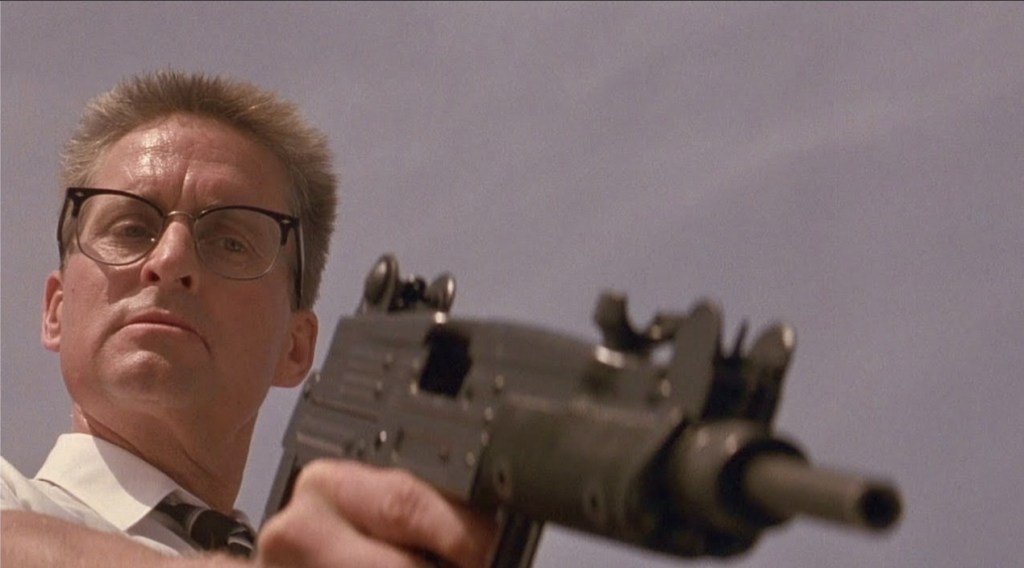
The performances are great, with Douglas in particular revelling in teasing his macho image. Clad in cracked glassed, a white shirt and tie, with biros lining his breast like a giant nerd from an episode of Saved By The Bell, he often looks every bit as bemused by his push back as the people he’s railing against. But while the actor nimbly flits between comedy and tragedy (“I’m the bad guy? How’d that happen?”) as a struggling to realise that he’s actually the villain in his story, gravitas to provided by “old faithful” himself, Robert Duvall. The joke is that his mind mannered Prendergast, with a dead daughter, endlessly histrionic wife and lack of respect at work has just as much reason to despise society as the man he’s tracking, and yet he’s managed to cleave a path by being more understanding and empathetic that the people around him. Elsewhere, we find Schumacher leaving crumbs to show that D-FENS isn’t quite the targeted victim he believes he is (watch Barbara Hershey’s ex-wife struggle to get the uncomprehending male cops to understand her restraining order), but again, he can’t help to cheekily muddy the waters even further by having the citizens of LA mostly behave like supremely bad tempered NPCs from Grand Theft Auto.
Weirdly enough, I would debate that Falling Down may not be quite the either/or debate piece it once was due to the fact that modern audiences are far more familiar with issues such spousal abuse and mental illness – although I’m pretty sure some just label it as Angry White Guy: The Movie without digging into some the more subtler aspects.
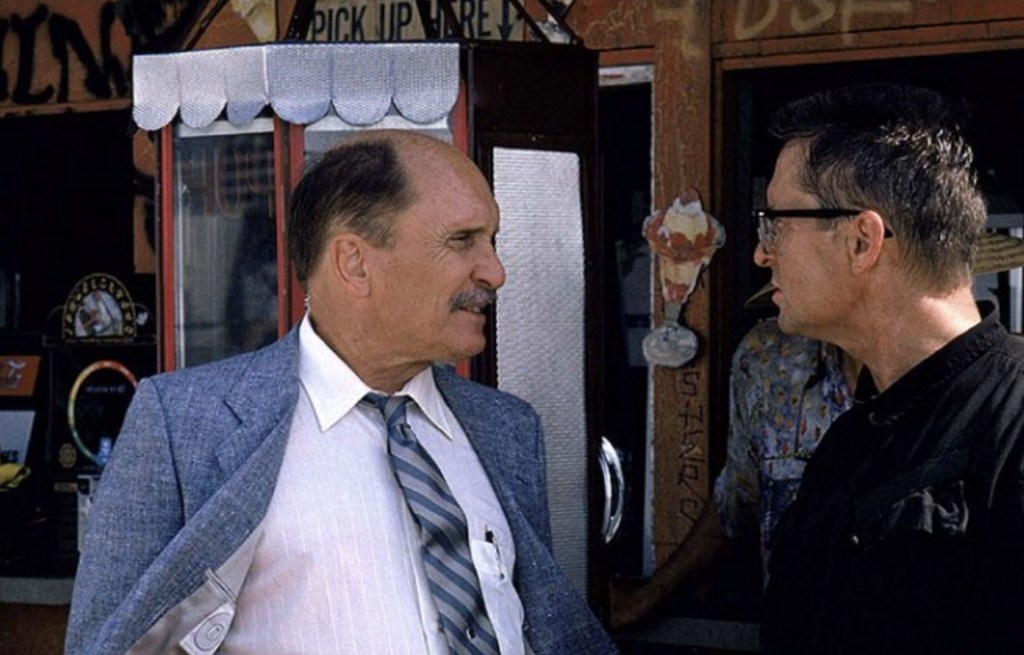
Obviously while Falling Down is more famous for its hot button issues, maybe what isn’t mentioned enough is that Schumacher’s sweaty opus is a nicely smash mouthed thriller in its own right. Watching Duvall’s cop find his stomach while Douglas’ wannabe hero loses his mind is one of the many reasons that Falling Down still stands tall.
🌟🌟🌟🌟

 We Have Issues
In memory of Robert Duvall, this is certainly one movie worth reflecting on. As well one of the best movies to remember Michael Douglas for in a role that makes us contemplate so much. Thank you for your review.
LikeLiked by 1 person