
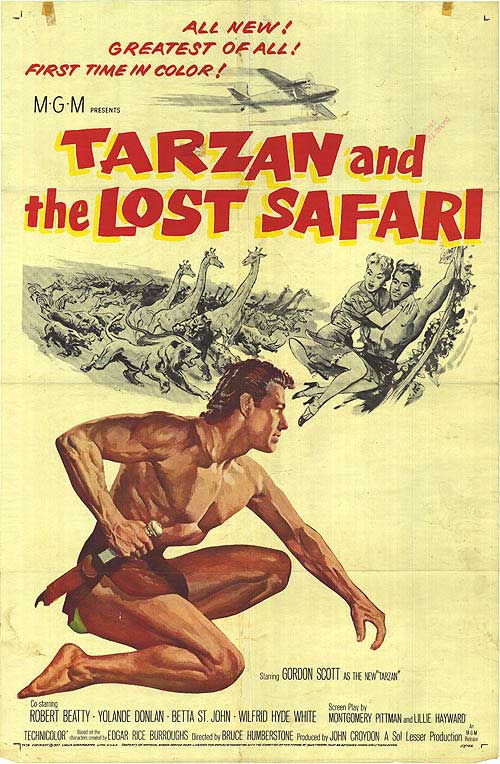
Life in the jungle can be brutal, so it’s fairly fitting if I unleash some brutal honesty and declare Gordon Scott’s debut as Tarzan as a bit of a limp swing. 1957s Tarzan’s Hidden Jungle may have introduced us to Scott’s impressive physique (seriously, the dude was a damn tank), but as derivative, bland movies based on Edgar Rice Burroughs’ legendary hero go, his inaugural outing hardly lit a fire under The efforts of previous swingers Johnny Weissmuller and Lex Barker.
However, with his next film, Scott managed to score something of a coup by appearing in the first Tarzan movie shot in colour meaning that the franchise was finally gifted with all the greens, blues and browns that made Tarzan’s jungle habitat virtually explode off the screen – but more than that, Tarzan And The Lost Safari manages to be a massive improvement over the previous installment in virtually every way. Once again there’s no Jane and no Boy to be seen, but what we do have is Scott now starting to get comfortable in that iconic loin cloth and a Cheeta at her most destructive – and that’s saying a lot.
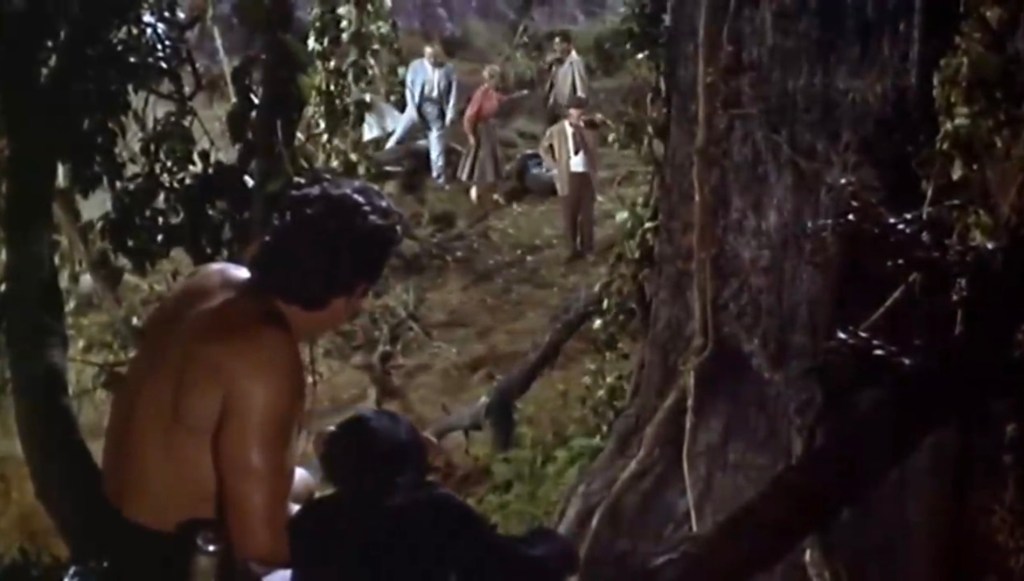
Soaring above Africa in their private plane, a cluster of well-to-do Americans are attempting to revel in their jet setting ways as they fly from one extravagent engagement to another. However, among the cocktails and self congratulatory behavior, there’s tensions that have built up between thrill-seeking playboy Dick Penrod (now there’s a name) and his bored wife Diana – but as the snark between them grows ever more hostile and spiteful, a more pressing problem rears its head when a flock of flamingoes goes full kamikaze on their engine and the party crashes in the jungles of Kenya.
Miraculously no one is hurt, but the chief reason that everyone makes it off the peecarious wreck before it tumbles into a gorge us the arrival of Tarzan, lord of the apes, who takes it upon himself to make sure this band of horribly unprepared authors and party girls make it out of the jungle alive.
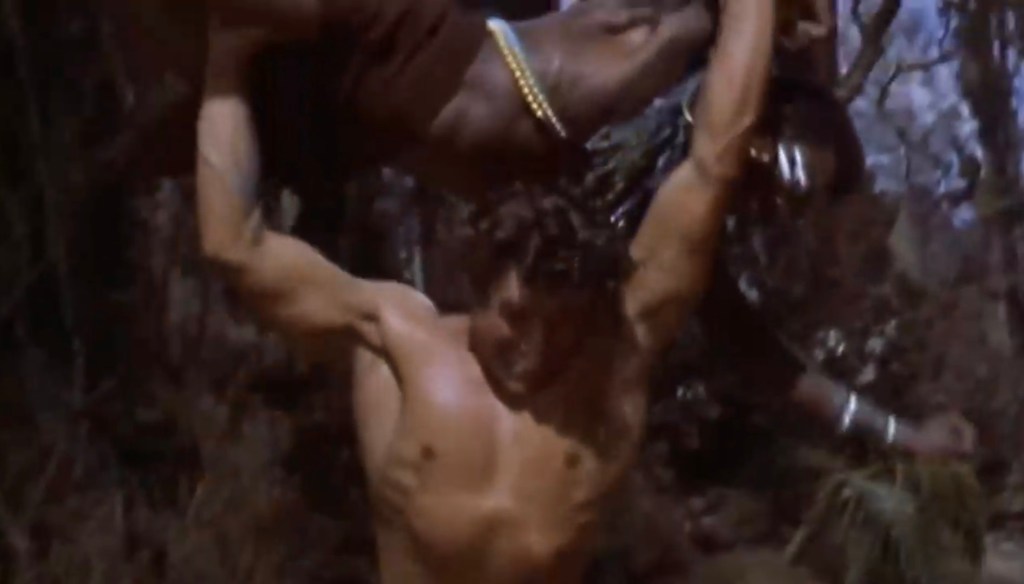
However, it’s not the razor toothed beasties and poisonous creepy crawlies that bothers Tarzan so, but rather the close proximity of a tribe of natives known as the Opar whose chief seems dead set on sacrificing any white person his men can lay their hands on and after single handedly beating the shit out of a group of them after they try and kidnap Diana, it seems that Tarzan’s fears are bang on the money.
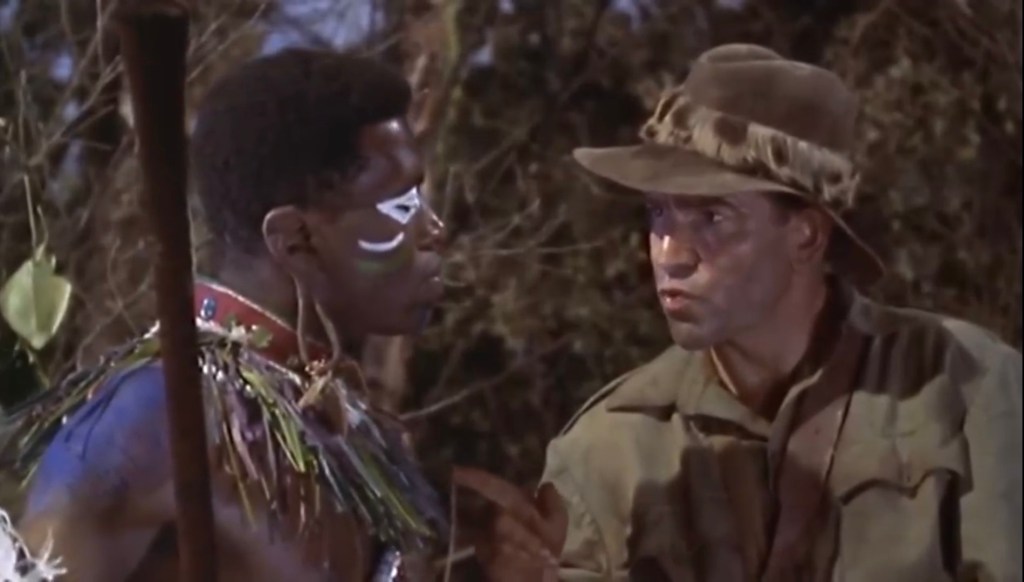
However, there proves to be a wild card in the mix in the form of grizzled hunter Tusker Hawkins, who also aids in Diana’s rescue and seems to share Tarzan’s feelings about getting the survivors to safety. But if we choose to look a little closer, we’ll see that Hawkins is something of an opportunistic bastard who had a deal with the Opar chief to deliver him these prospective sacrifices in exchange for letting him get his hands on piles of ivory.
While Tarzan has his reservations about this “extra help”, Tusker aims to split the group down the middle by turning Dick against his rescuer by pointing out the obviously goo-goo eyes his wife is aiming at the half-naked hero.
It always seemed weird to me that the head honchos behind the Tarzan franchise would introduce a brand new Tarzan with such a bland and lifeless movie, but if we were to play the long game, we would see that Gordon Scott and his inexplicable Elvis Presley-style pompadour would eventually get progressively better projects that would eventually crest with the kickass adventure film, Tarzan’s Greatest Adventure in 1959 – well, consider the road to that franchise highpoint starts here as Tarzan’s And The Lost Safari proves to be a huge improvement.
While the various actors who played Tarzan before him essentially had their roles quite plainly laid out in front of them, Scott’s Tarzan always seemed to be undergoing a period of refinement, constantly switching out such iconic mainstays as Jane, Boy and Cheeta and gradually having the actor go from the stilted broken English of Weissmuller and Barker to the educated jungle crime fighter that the likes of Mahoney and Henry went on to portray
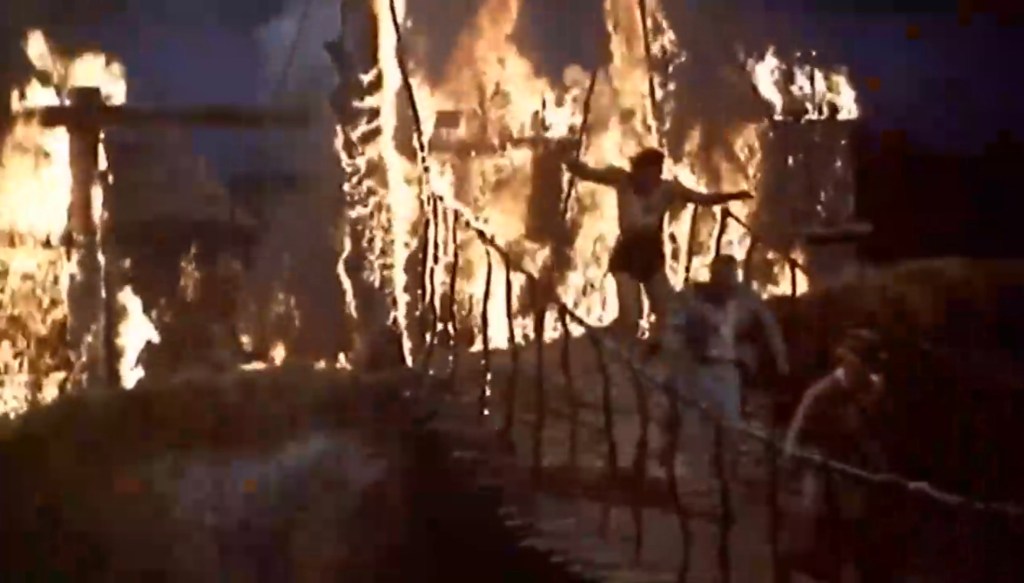
For example, who Scott is still very much in the “Me, Tarzan” phase of the character, here he’s pound for pound a far smarter and crafter version of the character than we’re used to. Watch him gradually figure out Robert Beatty’s conniving villain in a satisfying manner and later, we get to watch him shrewdly take on an entire tribe by a spot of misdirection thanks to a spot of quick misinformation on the the old drums before unleashing the full destructive power of Cheeta’s intrusive thoughts while she’s pissed off her monkey tits on boozs and armed with a lighter onto the straw huts of their village.
Watching a far sneakier Tarzan allow his ape companion to go full arsonist seems to infer that the filmmakers are actually trying to riff on Burroughs’ original stories for a change, but a scene were Tarzan actually delivers a semi-accurate account of his origin flat out proves that the franchise seems eager to take him away from his husbandly phase and doubles down on it by having him getting well and truly eye-humped by both women in the cast for the literal entirety of the film. It actually works really well as our hero isn’t desperately trying to rescue the same old characters from the same old situations and heightens that all-important feeling of high adventure that these movies need to thrive. In fact, speaking of high adventure, a climax that involves Tarzan and Tucker dangling from a severed rope bridge while enraged use them for target practice with spears is eerily reminiscent of the ending of Indiana Jones And The Temple Of Doom and just goes to show that even though Tarzan’s safari may be lost, they’re definitely heading in the right direction.
It ain’t all flexing biceps and fire-bug apes, however. While the plane crash plot manages to keep things impressively fresh, the ensemble keep things interesting (some prime pithy one liners from Wilfrid Hyde-White certainly help) and the action moves at a fair clip, once again the rather problematic and frustratingly unavoidable (for the 1950s at least) use of African American actors as a tribe of villainous “savages” who seem to enjoy nothing more than randomly sacrificing white people to their permanently ticked off God just feels awkward in these times as they’re are mostly portrayed as caucasian hating thugs who are regularly routed by our muscular hero. While I understand that things were different back then and that it comes part and parcel with the whole Tarzan vibe along with duplicitous trappers and stampeding elephants, but that doesn’t make it any less iffy when it happens and it’s something of a detriment to such an otherwise fun movie.
After a slow start, Gordon Scott’s tenure as Tarzan finally gets a boost fitting of his formidable guns and bowling ball pectorals, and despite some arguably inevitable racial issues (again: for the 50s – don’t wanna step all up in that mess), Tarzan And The Lost Safari is an above average helping of adventure based shenanigans. Scott’s best? Not by a long shot. Not yet. But as an upgrade from a rather woeful debut, this lost safari deserves to be found.
🌟🌟🌟

 We Have Issues
One comment