
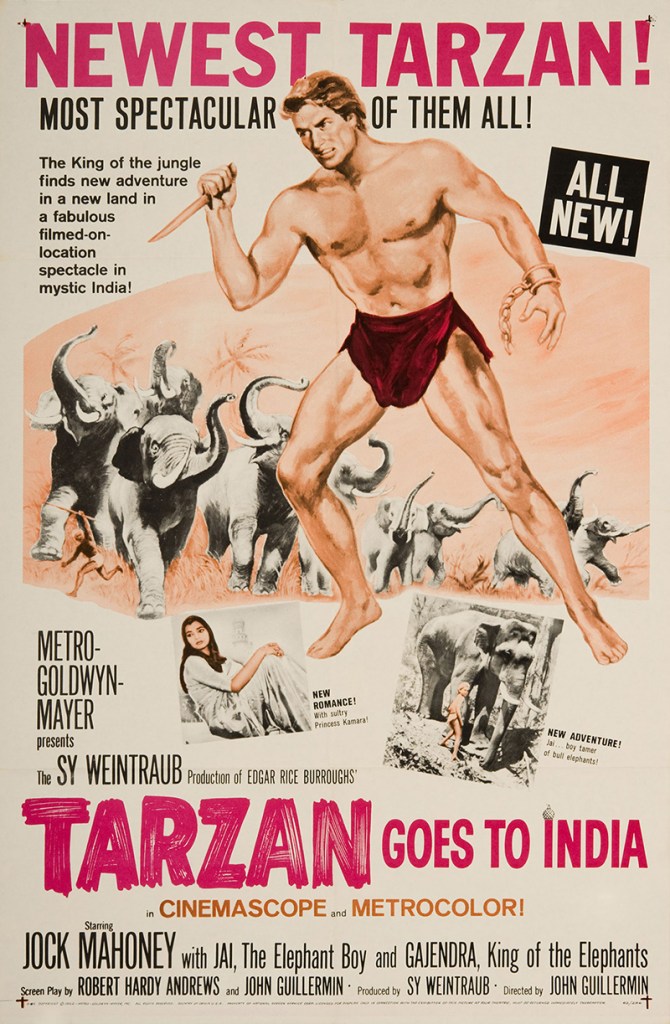
By the time 1962 rolled around, it was all change again for the Lord of the Apes as the obscenely muscular Gordon Scott made way for the noticably more grizzled Jock Mahoney who still holds the record for bring the oldest man to rock the loin cloth. But it wasn’t just the shift in actor that marked a big change as producer Sy Weintraub decided to take the vine swinging yodeller out of the jungles of Africa and into the jungles of India in a move that saw Tarzan without a home field advantage for the first time since Johnny Weissmuller’s trip to New York.
However, despite the whole movie being filmed on location and the truly impressive sights of huge, powerful elephants doing their stuff, Tarzan Goes To India had to contend with following up a couple of Tarzan adventures that were rollicking examples of adventure – so could a physically smaller Tarzan negotiating an unfamiliar territory manage to keep the jungle man swinging?
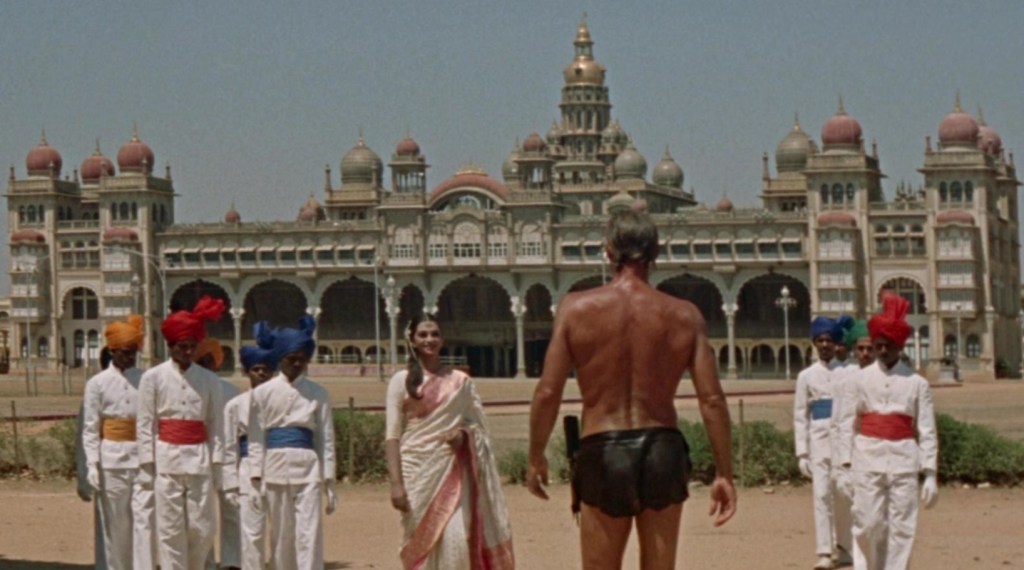
After being summoned to India by a sickly old friend, Tarzan arrives to help sort out some problems that’s been occuring thanks to the building of a hydroelectric dam. It seems that the poorly Maharaja has dedicated his life to creating an animal sanctuary that now is home to a shitload of elephants, but when the dam is switched on, the entire area of “useless jungle” (not my words) will be full of both water and over 300 drowned pachyderms.
Why can’t the elephants just be driven out, I hear you ask? Well, they’re being led by a rogue elephant who is so driven by rage and fear, it won’t lead them out of the narrow pass through the surrounding mountains and the only way Tarzan is going to get the tusked mammals out of there is to take out that rogue. However, also causing problems is Bryce, one of the two head engineers who has had a past altercation with Tarzan thanks to his fondness for shooting elephants back in Africa for their ivory.
However, an unconventional solution to the elephant problem comes from Jai, a small ophan child who has befriended an elephant named Kajendra and has been leading attacks on the dam to slow things down and after withstanding the boy’s superpower of being an intensely annoying kid sidekick, Tarzan enlists his help to help him sort out that pesky rogue.
With time running out, and Bryce deciding to pull all the classic villain shit that comes with being a utter dick in a Tarzan movie, the Lord of the Jungle has to figure out how to take out both a violent elephant and a murderous engineer who values life less than a snotty handkerchief.
It’s time for Tarzan to take them to tusk… uh, I mean task.
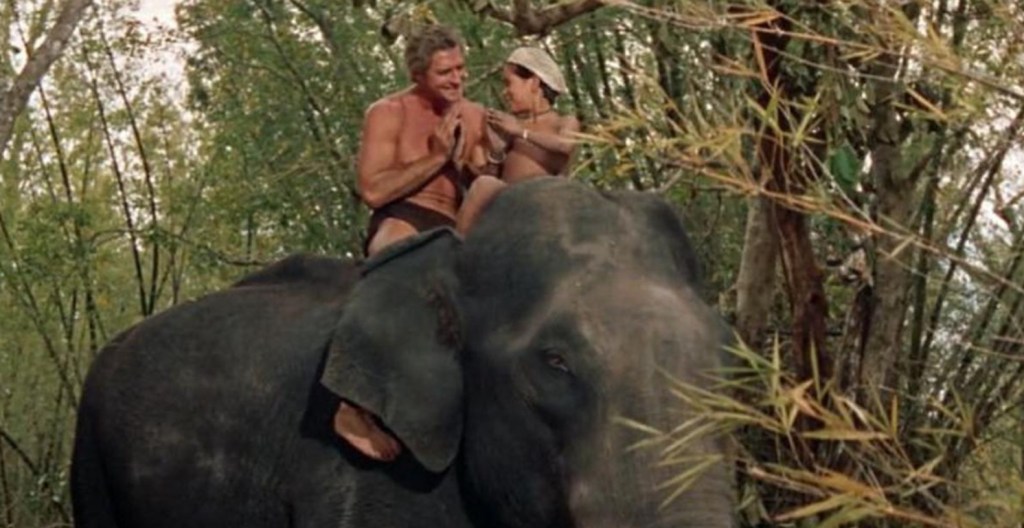
So, I don’t mean to start things by body shaming Tarzan – after all, the only way I could get a physique like any version of Tarzan is if I got my hands on a magic lamp – but having a noticably leaner jungle lord in the shape of the wonderfully named Jock Mahoney feels a little like a step backward when you consider that his predecessor was put together like a freakin’ superhero. Still, a lack of bulging pectoral muscles and abs you could grate cheese on doesn’t mean Mahoney isn’t up to the task. He can swim, swing and brawl with the best of them, but what might have proved to be particularly confusing for audiences at the time was that the actor portrayed a baddie in the previous Tarzan movie, Tarzan The Magnificent.
However, while Mahoney gets a fairly memorable introduction – why wait for your biplane to land when you can just hurl yourself out of it into a passing lake and swim to your rendezvous – he simply doesn’t have the charisma to withstand that he mostly has to act opposite the dreaded bane of all action adventure movies: a mouthy child sidekick whose ego writes checks his age can’t cash and who won’t shut the hell up at any point. I’m sure kids at the time must have been enchanted by the sight of a child their age who owned their own elephant and got to hang with a half naked dude in the jungle (wait, hang on a minute…), but his constant complaining makes rhe trouble-prone Boy out to be a stoic influence in comparison.

Elsewhere, Tarzan Goes To India finds that time hasn’t exactly found itself on the right side of modern viewpoints. Thankfully, the people of India aren’t treated anywhere near as badly as African natives are in earlier Tarzan films and a couple of strong characters makes sure that the Indian characters aren’t just gawping onlookers, but some of the film’s messages get a little garbled as the film goes on. Simi Garewal’s princess demands that the animals be saved and the torn Raj demands that the odious Bryce treat human life with respect, but in the end, everyone’s problems are sorted by two white guys fighting it out. Also, the movie doubles down on the preservation of animal life (despite Tarzan fucking up the odd spot of wildlife that looks at him funny), yet cheerfully declares at the end of the film that the elephants that they’ve just saved could be put to work to help finish the dam – uh… yay?
Probably the most damning part of Tarzan Goes To India is that the movie doesn’t really explore the issues Tarzan might experience while being away from his own kingdom. However, the movie maintains that the trial and tribulations of the Indian jungle isn’t that different from the African one and just stubbonly maintains that an elephant is just and elephant, wherever it’s from. This results in diffusing any tension that might have been generated by our hero being off his game and its further exasperated by the fact that his rivalry with serial wrong-dooer, Leo Gordon isn’t really given a chance to breathe and is actually resolved at the incredibly early fifty minute mark.

You still get your money’s worth with a genuinely impressive final charge of a heard of elephants that’s pulled off without a lick of visual effects (although animal lovers may be understandably unsettled) but among all the loud trumpeting and wanton property destruction, you kind of wish that the movie ended with the slightly more traditional sight of Tarzan brutalizing and absolute heel who gets off on raping the natural world instead of shoving Leo Gordon’s Robert Shaw-like rotter under the rug a good thirty minutes before the credits roll.
One of the more tonally accurate Tarzan movies to Edgar Rice Burroughs’ original stories, Tarzan Goes To India nevertheless squanders the outsourcing of his titular adventurer on kid sidekicks, muddled eco-messages and a whole mess of elephants.
🌟🌟
 We Have Issues