
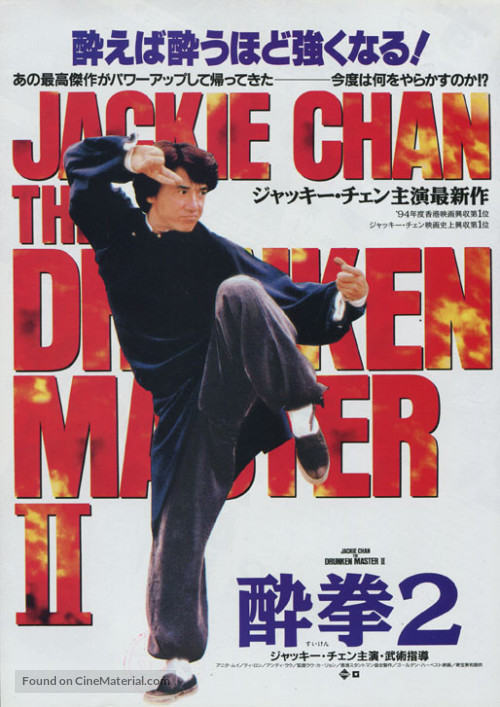
If you ever wonder what it was that convinced the powers that be to give Jackie Chan one more shot at Hollywood, chances are it was the flabbergasting carnage that unfolds throughout Drunken Master II. At this point in Chan’s career, his legend had finally got to the point where his 90s releases were finally getting cinema releases in the west and before multiplexes braced themselves for an onslaught of the likes of Rumble In The Bronx, First Strike and Who Am I?, the first to plough onto screens like an inebriated fist was Drunken Master II.
To avoid confusion with the fact that the movie was a sequel to a film made in 1978, the follow up was renamed The Legend Of The Drunken Master, but whatever it was called, audiences were not prepared for a slice of action/comedy that featured a climax that almost – almost – tops the frantic excellence of Police Story. So grab a brewski or ten and prepare yourself for a flurry of comedic set pieces that’ll make you punch drunk in no time.
It’s the early 20th century China and we rejoin Wong Fei-Hung as he travels with his father and their servant back to Canton by train after collecting supplies for their medical business. However, a string of misunderstandings and misconceptions are soon kicked off when Wong intercepts who he thinks is a common thief that is trying to swipe his ginseng root, but who actually is Fu Wen-chi, a man who is desperately fighting to stop British colonisers from smuggling Chinese artifacts out of the country. What Wong actually succeeds from retrieving from Fu is the Imperial Seal and with it comes a whole mess of trouble.
While the British Consul sends some Chinese henchman to retrieve the artifact, Wong, and his doting but scheming stepmother, Ling, try a whole mess of farcical schemes to try and get money to get a new batch of ginseng without the patriarchal Wong Kei-ying finding out. However, between numerous crazy plans, absurd lies and random bouts bout of Kung-Fu, it soon becomes obvious to the bad guys where they need to look in order to locate the Imperial Seal.
These unscrupulous villains aren’t beneath hiring an army of crooks, such as the Hatchet Gang, to take Wong out and reclaim their prize, but a far more bruising blow is struck when Wong’s father discovers that his son has been fighting and drinking – which is admittedly a necessity when fully activating his drunken boxing fighting style – and in a fit of rage, banishes Wong from the household.
Understandably emotionally wounded, Wong is about to get physically wounded when the bad guys make their final move, but in realising that the very history of his homeland is at stake can our hero weather the storm of fists, fire – and possibly liver damage – that’s about to come his way?

There are few immutable facts in cinema, but surely one of them is that Jackie Chan is an iron clad original that will never be duplicated. His martial arts prowess, twinned with a sense comedic timing that could rival even Charlie Chapin, has provided action cinema with jaw dropping moments that simply can’t be equaled, even in movies that sometimes don’t really deserve them. Love the ladder scene in First Strike, or the two-on-one rooftop brawl in Who Am I?, but find the films themselves a bit lacking? Well you certainly don’t have to worry about that here as along with some truly gobsmacking (both figuratively and literally), Drunken Master II also delivers a hint of cultural gravitas to temper all that dizzyingly complex pratfalling.
First, the serious stuff and it’s incredibly impressive that the film that finally proved that Chan could impact the worldwide box office is one that has a massive, anti-colonial theme running right through it. Right from the beginning, the detrimental effect British rule was having on Chinese culture is very evident, with the fact that various priceless items of Chinese culture was being hoovered up left and right in order to languish in a museum somewhere playing a massive part in the story. Nowadays, this sort of thing gets brought up fairly regularly in popular culture (hello, Black Panther), but in 1994 it was something of a sticking point, but it gives the movie something incredibly important to hinge on when shifting gears from the violent clowning to the far more vicious final act.
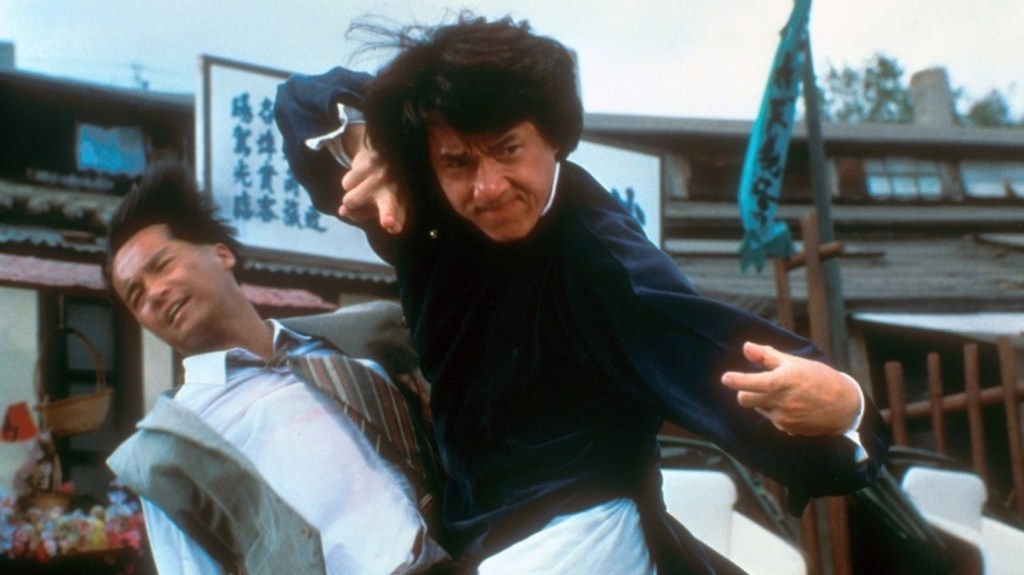
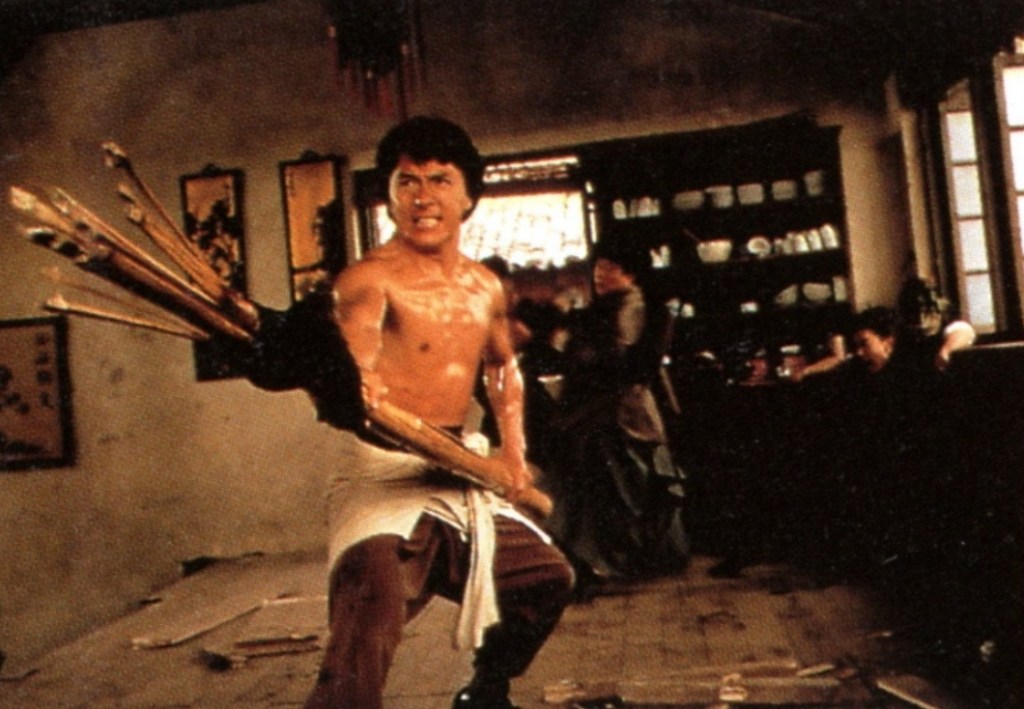
While I will freely admit it’s fairly a tall order to still buy Chan – who was 40 at the time – as the young man the movie would have us believe hes supposed to be, the fact that he was plummeting into middle-age certainly didn’t seem to slow him down much and when it comes to sheer speed and impact, Chan’s only been better in the orginal Police Story, a movie made roughly a decade prior. Simply put, Chan’s a fucking beast – whether somehow engaging in a lightning fast, spear verses sword fight with Lau Kar-leung while crouched under a stopped train or effortlessly fighting off an army of hatchet waving thugs with a giant, homemade bamboo flail, the invention here is nothing short of stunning. I mean, how the fuck to you even begin to choreograph a fight where two people are crouching the entire time – let alone under a sodding train?
But as thrilling as the blurring fisticuffs are, the balance of humor is also on point. However, the big laughs don’t actually come from Chan, but rather from Anita Mui’s insanely shady stepmother who displays some keen comedic powers herself, especially when barking slurred, incomprehensible orders after taking a sock on the jaw, or locating more booze in order to keep her step son pissed up enough to continue fighting.
However, a martial arts movie is only as good as it’s best fight, and while director Lau Kar-leung and Chan apparently clashed intensely over the choreography, the tension seemingly made it’s way into the climactic beat-down which ranks as one of the most intense fights that the actor has ever participated in. The fact that it falls a mere one-inch punch short of the peerless final brawl seen in Police Story was something I thought genuinely couldn’t happen and the sight of the participants rag dolling each other while using everything from chains to fire to inflict as much bodily damage that they can adds more gravity than the surface of fucking Jupiter. In fact, the moment where Wong drinks industrial alcohol in order to get blootered enough to win the fight – right down to him hiccuping actual bubbles – may actually be the most insane moment in Chan’s entire fighting history.
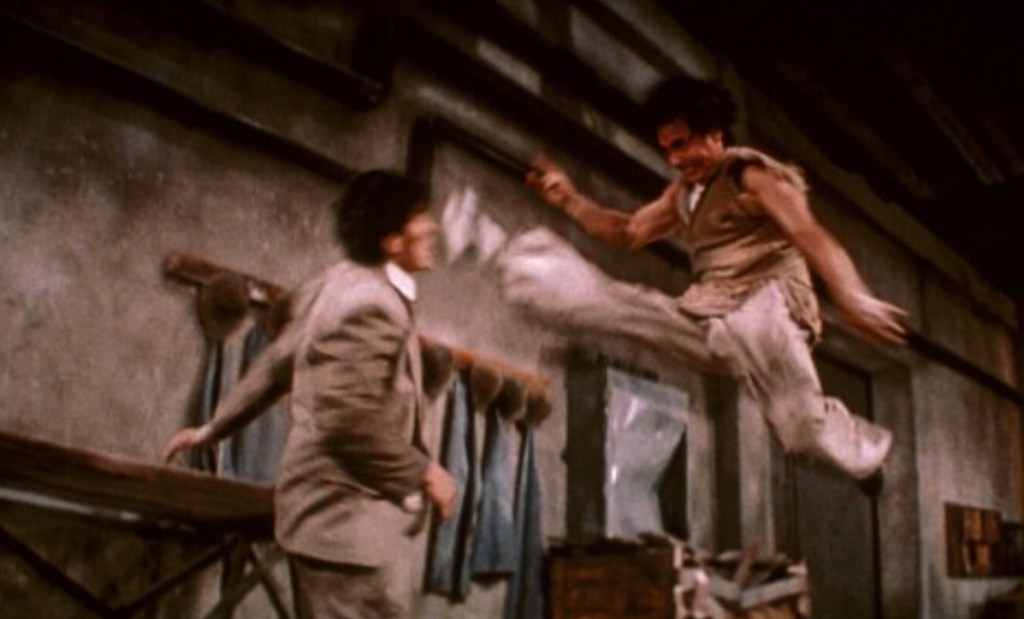
A literal high point in a career full of slips, trips and brawls that remains virtually undefeated, Chan literally rolls over hot coals to guarantee that Drunken Master II is certainly worth raising a glass – or even an entire vineyard – to.
Punch drunk loved.
🌟🌟🌟🌟🌟
 We Have Issues