
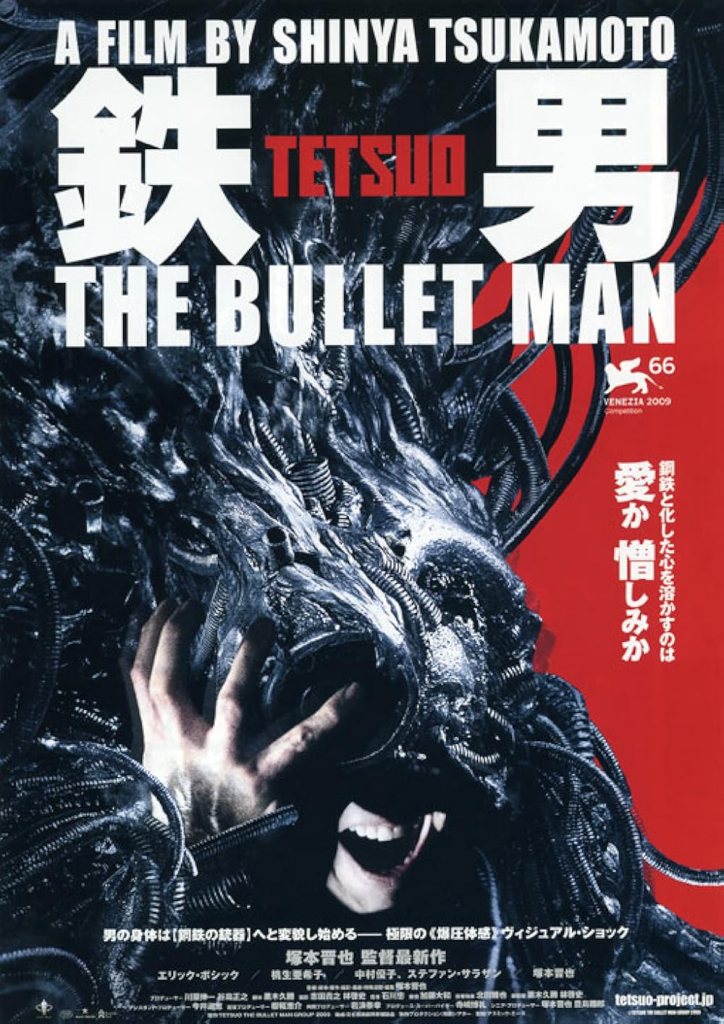
Emerging from the the grainy, black and white frazzle of an 80s avant garde, art house experiment, came Shinya Tsukamoto’s Tetsuo: The Iron Man, a mind-fucking decent into industrial body horror that dispensed with such trivial needs as a coherent plot and nuanced characterization in order to deliver an hour long primal scream directly at the camera. A few years later, Tsukamoto went the Evil Dead II route by essentially remaking his debut with Tetsuo II: Body Hammer and added a splash of colour and a heftier budget to this industrial nightmare of a vision that frequently saw downtrodden “salarymen” have their primal impulses jump started into violent live by the arrival of a seductive, mysterious figure played by Tsukamoto himself. And then the Tetsuo engine went silent as the daring filmmaker understandably went off and focused on other, equally challenging projects as the misshapen, metallic husk of the “franchise” grew cold.
But then, suddenly, the machine flicked back into life and Tetsuo’s gears and cranks started turning once more with a third movie – but the year was 2009, and a lot of time had passed since Body Hammer. Did Tsukamoto have enough fuel in the tank to get this rage powered machine back up to optimum levels?
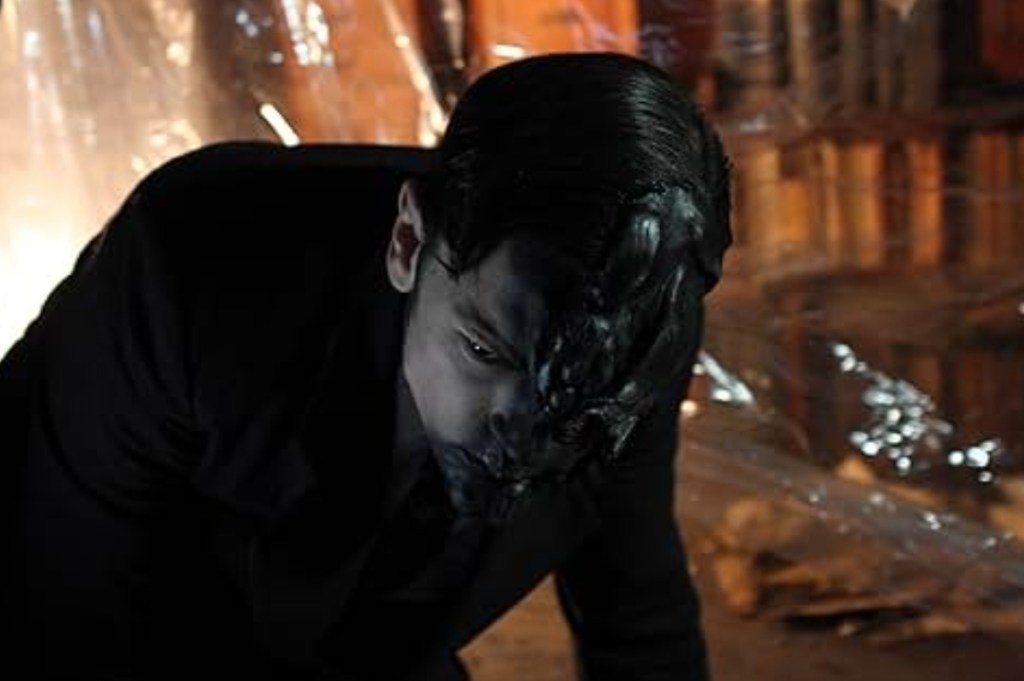
Anthony is a man living in Tokyo who is of both Japanese and American descent who tries to enjoy life with his wife and son despite frequent violent nightmares that seem to plague him on a nightly basis. However, one day his nightmares become devastating reality when his son is murdered in a hit and run incident, but after the incident a wedge is driven between Anthony and his Japanese wife, Yuriko, when she is disgusted by his desire to just go on with his life when she wants them to head out and kill the man responsible.
Anthony’s brooding grief is soon switch to anger with the arrival of a hitman who nonchalantly shoots him in the face on the orders of Yatsu, an enigmatic force of chaos who hopes to fire up a long dormant power that resides within his tormented target. Unsurprisingly (for a Tetsuo film, at least), it works, and before you know it an enraged Anthony is sprouting all manner of metal protuberances as he transforms into a cyborg-esque beserker with gun barrels sticking out of his chest. Further adding to his furnace-like rage is the fact that Yatsu cheerfully admits to being the man who ran over his son which ends up with a maddened Anthony first wounding (but not killing) an entire PMC team before trying to take his own life.
However, suicide is rarely a way out in a Tsukamoto movie and after reconciling with his wife, the mutated Anthony heads out to confront his father concerning the fact of his birth and how it pertains to the fact that he now looks like a living anvil.

Tsukamoto’s first Tetsuo was a ferocious conundrum of a film that compensated for its meager budget with a string of stunning visuals which played like David Lynch’s Eraserhead dragged through a scrap yard. Body Hammer may not have been as overtly provocative (the first movie ended with the hero and villain merged into a giant tank that sported a massive errection, after all), but the fact that Tsukamoto had become a more, seasoned filmmaker meant that his bonkers vision had never looked better as the franchise shifted from techno-horror to including a strong influence anime into an almost superhero story.
However, with such a huge gap between the second and third movie (I wasnt aware it had even been made until a year ago), there was a question if whether Tsukamoto still had the fire needed to make a new Tetsuo movie valid and brutal enough to justify its existence. Well, I’m rather frustrated to admit that The Bullet Man flies wild off the mark with a third entry that not only is missing the raw invention of the first two, but actively makes you wonder why the director even bothered.
That’s not to say that the belated trilogy capper doesn’t have anything to offer, it’s just that it doesn’t come up with anything new when retelling the familiar old story of insipid wage slave turning into a mechanical, clanking superpowered hulk. If anything, Tsukamoto has diluted his original concept with a movie that feels more like a response to the rise of the superhero movie rather than a defiant bellow at the notion of the loss of self due to a claustrophobic life of consumerism.

Similarly, the return of Tskamoto’s villainous on screen alter-ego (formerly known as The Metal Fetishist but here simply referred to as Yastu) made that the director is once again onscreen, goading a lump of screaming metal into detonating the city – or something – but while previous versions of this antagonist have proven to be an interesting enemy, this newest incarnation seems listless, predictable and his plans don’t seem to make much sense – even in the fucked up logic of the Tetsuo universe.
However, possibly worst of all, the third movie is, for some reason, has been filmed with everyone speaking mostly in English which proves to be rather disastrous for two reasons.
The first is that not all the cast counts English as their first language (or even their second by the sound of it) and as a result, a lot of important exposition is all but obliterated by a string of double-thick accents. However, the other problem is that the english speaking actors simply don’t have the emotional chops to pull off a lot of Tsukamoto’s more stilted dialogue and soon long for the days when men who are painfully turning into biomechanical weapons of mass destruction screamed their objections in rasping Japanese.
However, it’s not all bad. If your inner ear can stomach the director’s typical love for violent shaky cam (at times it makes The Blair Witch Project look like it was shot by Kubrick), then there’s a certain amount of nostalgic fun watching the Tetsuo universe once again go through its metamorphic motions even if there’s a nagging sense that its creator has somewhat sold out (A happy ending? In a Tetsuo movie?).

Plenty of frantic camerawork and whiplash inducing edits still manage to add some steel to The Bullet Man’s metallic bite, but even the sight of a living weapon juggernauting his way through a screaming SWAT team with high calibre abdominals feels curiously dated in a time where slightly more positive mergings of man and machine such as The Matrix and Iron Man now exist.
Tsukamoto’s Iron Man now seems to be nothing more than a tin soldier.
🌟🌟
 We Have Issues