
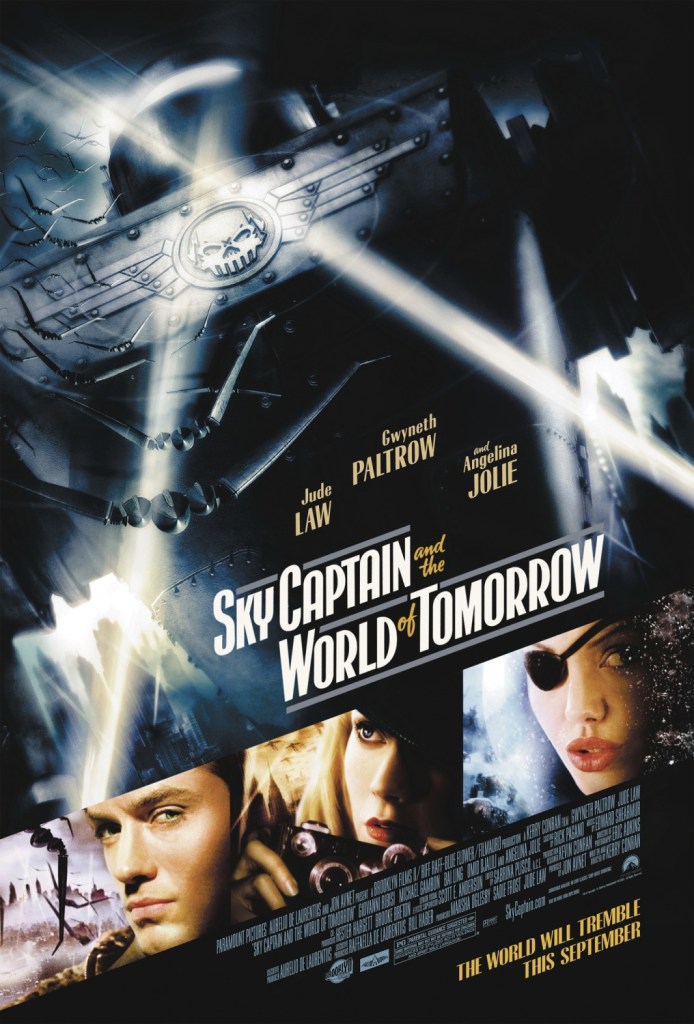
Nestled somewhere between the CGI sets of George Lucas’ Star Wars prequels and the green screen artistry of Sin City and 300, lies Sky Captain And The World Of Tomorrow, an experiment in digital filmmaking that virtually no one ever name checks. The aim was simple: create an entire movie where virtually all the surroundings were whipped up in a computer in order to create a style of blockbuster that had never been done before – at least not to this extent.
Lining up such faces as Jude Law, Gwyneth Paltrow and Angelina Jolie in front of garish green backdrops in the hope of creating movie magic was director Kerry Conran, who hit upon using all this bleeding edge technology to niftily invoke the past by skewing hard to such influences as movie serials from the 1920s to full on German Expressionism. However, with all this ambition, does Sky Captain actually fly as high as it concept suggests?
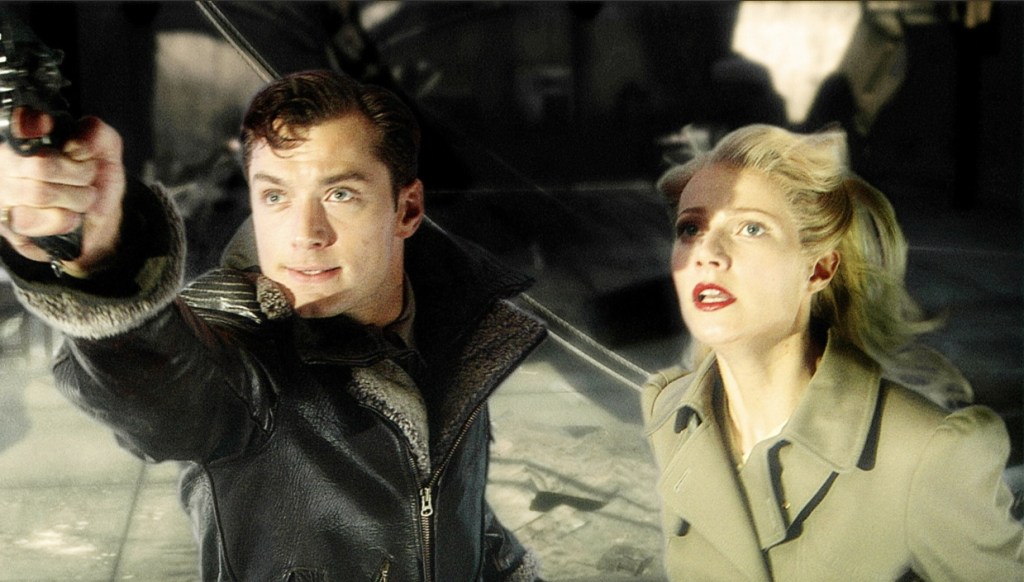
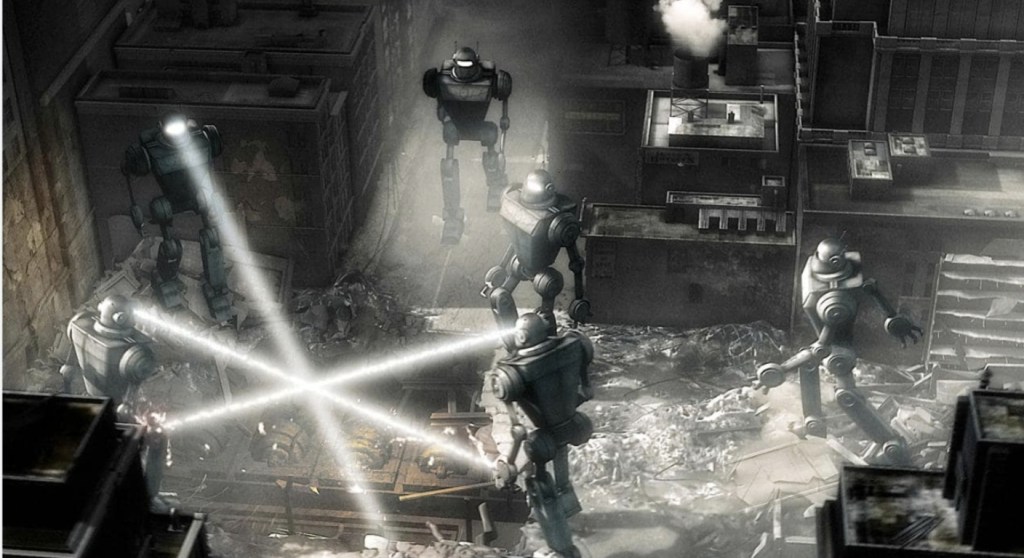
In a technologically advanced 1939, we find ace reporter Polly Perkins trying to crack a story involving kidnapped scientists when her work is rudely interrupted when an army of giant robots suddenly starts marching through the streets of New York City. As they waste to various parts of the neighbourhood, their advance is halted by the arrival of the dashing Sky Captain, an air ace who is the city’s hero and who leads a mercenary air force named the Flying Legion. He also just happens to be Polly’s ex and after the robots have ransacked various parts the city for machinery they need and left, he takes some time out from hero-ing to engage in some passive aggressive banter with the aggressive reporter.
As they compare notes and exchange barbs, they discover that the robot attack on New York and the missing scientists are all part of a multi-pronged conspiracy created by a mysterious German genius named Totenkopf to alter the very face of humanity and the mechanised forces of their enemy strike again when they launch a full scale attack on the home base of the Flying Legion. Things blow up and Sky Captain does some more daring acts in his tricked out plane, but ehen the smoke clears, it appears that the Flying Legion’s resident egghead, Dex, has been spirited away along with the other brainboxes who have been harvested by Totenkopf’s automatons. However, he managed to leave a clue that allows Sky Captain and Polly to fly across the ocean towards Nepal and finish this thing once and for all.
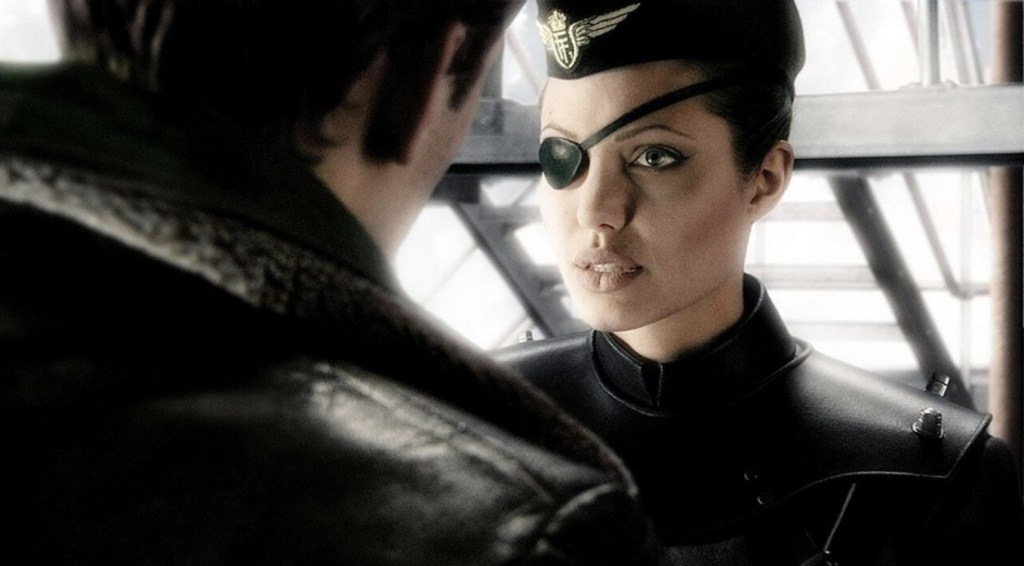
Getting help from one of our hero’s old flames, Commander Franky Cook, and her Royal Navy Flying aircraft carrier, attention is directed towards Totenkopf’s jungle fortress, but as the seconds count down on the scientists doomsday clock, all involved discover things are not quite what they seem.
When it comes to casting judgement over a movie like Sky Captain And The World Of Tomorrow, it helps to take into account exactly what the filmmakers were hoping to achieve. Yes, there’s a sizable, technological aspect to the film that can’t be ignored and proved to be something of breakthrough for the way visual effects could be utilised. On the other hand, Conran is also trying to revive a lost form of cinema that harkens enormously to forms of cinema that not only no longer exist any more, but might prove utterly alien to anyone who doesn’t get the joke. The fact that the movie delves into both so totally is such a big swing, it deserves all the credit in the world for trying something daring and fresh, however, for all of its ambition, Sky Captain And The World Of Tomorrow tends to work best if you treat it like the glorified experiment it kind of is.
There’s been numerous attempts to recreate the 1930s era of pulp hero, mostly during the nineties with such films as Dick Tracy, The Rocketeer, The Shadow and The Phantom all offering up lantern-jawed do-gooders who save the day with a two-fisted sense of justice and a helluva lot of moxie. However, despite this been a visually rich playground to screw around with, none of them have seemingly taken off as much as some would hope. Regrettably, Sky Captain proves to be the same despite (or maybe because) of its ballsy use of modern technology. On paper it’s virtually flawless. Retro robots clank around New York while getting buzzed at by the numerous gadgets of our hero’s swizz army plane, exotic creatures sun themselves on the Skull Island-alike isle where the villain makes his home and Angelina Jolie manages to wear an eyepatch and command a helicarrier years before Samuel L. Jackson got to do the same in The Avengers. However, while the attempts to breathe modern life into the old serial aesthetic contains all the Dutch angels, Germanic straight lines and retrofuturistic designs you could hope for, the whole thing feels frustratedly stilted, as if the reasons for the film’s very existence are the exact same things holding it back. Anyone not enamoured with the style will probably find large sections of the movie to be annoying slow and decidedly lacking in tension.
Additionally, the action scenes move strangely slow for sequences that sees our dashing lead fight robots with his funky aircraft or zap things with a space age ray gun, but that doesn’t even prove to be the worst of it.
It may have been dazzling back in 2004, but these days its overwhelming apparent that Jude Law, Gwyneth Paltrow and the rest are all standing in front of green screens while having no real connection with whatever the hell is supposed to be happening in front of them. Driving another nail into the coffin is that these days, a lot of the dialogue scenes resemble the cut screens from a PC game I’d probably have no interest in playing. Maybe this could have been circumvented if Law and Paltrow actually had any chemistry, but there is so little spark between the two, I was starting to wonder if all that technical jiggery pokery meant that the two never actual met in person on set. Elsewhere, despite her prominence on the poster, Jolie isn’t much more than a glorified cameo that allows her to dust off her Lara Croft accent one more time, Michael Gambon literally looks like he has no idea where he is and the digital resurrection of Laurence Olivier as a crackly blue hologram just feels a bit wrong.
However, much like a lot of the other, 30s set adventure revivals I mentioned earlier, I simply can’t bring myself to condemn it too much for its flaws simply because that’s what an experiment is supposed to do.

If you embrace the style with the love the filmmakers intended then I’m genuinely glad and I totally get why some regard Sky Captain And The World Of Tomorrow as something of a cult gem. But I just can’t get past the unavoidable issue that the very tools and concepts that made the movie so unique are the sane things that end up holding it back; but at least the use of CGI soundstages suited the comic adaptations of Sin City and 300 in a far more organic feeling way. A effort as valiant as its barrel-rolling hero, Sky Captain is nevertheless grounded by its inability to make its concept soar.
🌟🌟

 We Have Issues
I love Art Deco, I love Pulp Fiction. Should have loved this. Loathed it with a passion.
LikeLiked by 1 person
This movie wasn’t as appealing for me as I thought despite how artistically creative it could be. As a sign of how the FX visualizations were starting to drown out some better qualities for the cinema, it may have been inevitable in this case. Sin City and 300 were agreeably improvements. Thanks for your review.
LikeLiked by 1 person